SNPCAL
- Ed Post, Real Programmers Don't Use PASCAL, 1983
What began as a small code conservation project -- resurrecting examples of line printer calendars celebrated in Ed Post's 1983 "Real Programmers Don't Use PASCAL" -- took a turn into the history of computer crime legislation in the late 1970s and the surprising discovery that one bill, had it become law, would have made printing a Snoopy calendar punishable by 15 years in prison.
Line printer Snoopy calendar
November 2021
Making a version of the Snoopy line printer calendar was a short creative coding and code conservation project. As a starting point, I used a FORTRAN program snpcal.for that appears in the DECUS Software Library.
C     SNOOPY CALENDAR PROGRAM FOR PDP-11 FORTRAN
C     TAKEN FROM (NON-WORKING) IBM FORTRAN+BAL VERSION
C     MODIFICATIONS BY T. M. KENNEDY 29-DEC-84
The program generates (up to) a thirteen month calendar, each with an ASCII art Peanuts picture. The program can be compiled with GNU Fortran using the fdec DEC compatibility mode flag:
f77 -fdec snpcal.for snppic.for
where snppic.for is the routine that generates the images. Only the OPEN statements need to be modified and one line in the snppic.for routine needs to be commented out. The executable program reads data from snpcal.dat, a file representation of a punch card deck that contains runtime input (month range and year) as well as the encoded images and "large" text. The program output is written to snpcal.out in a Fortran format that can be processed by asa. There are 13 unique pictures that fill a glorious 132 lines of printed output:
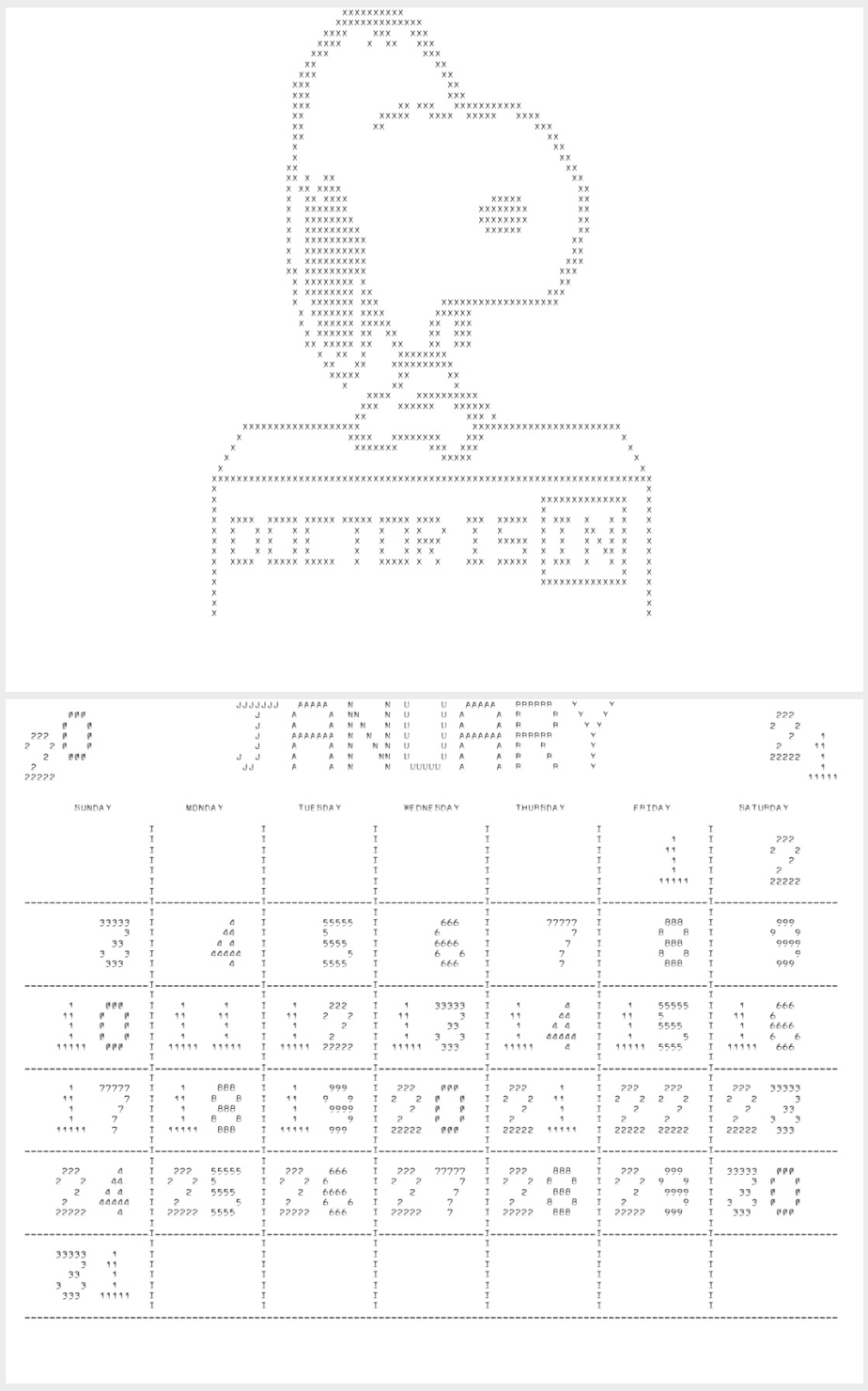
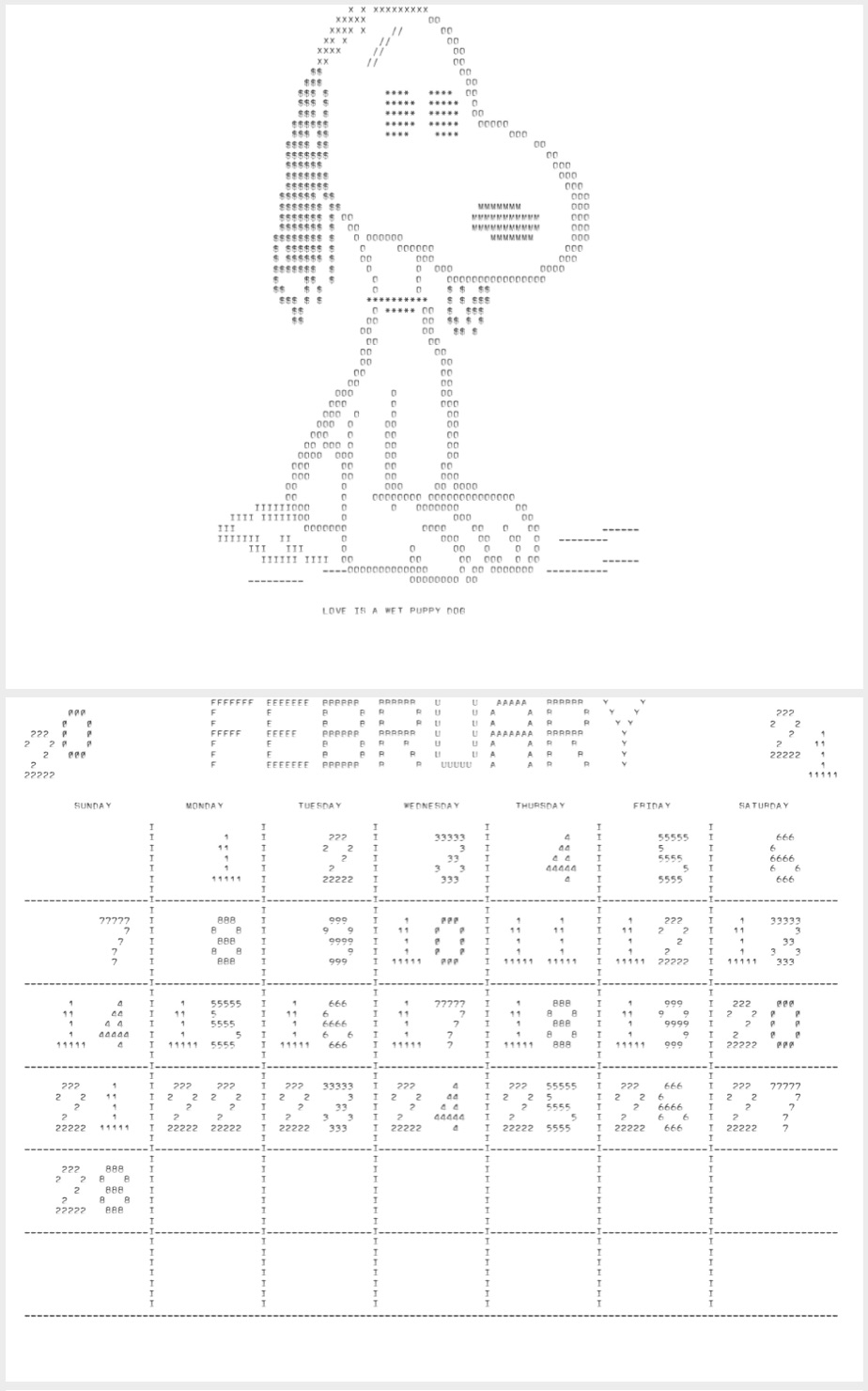
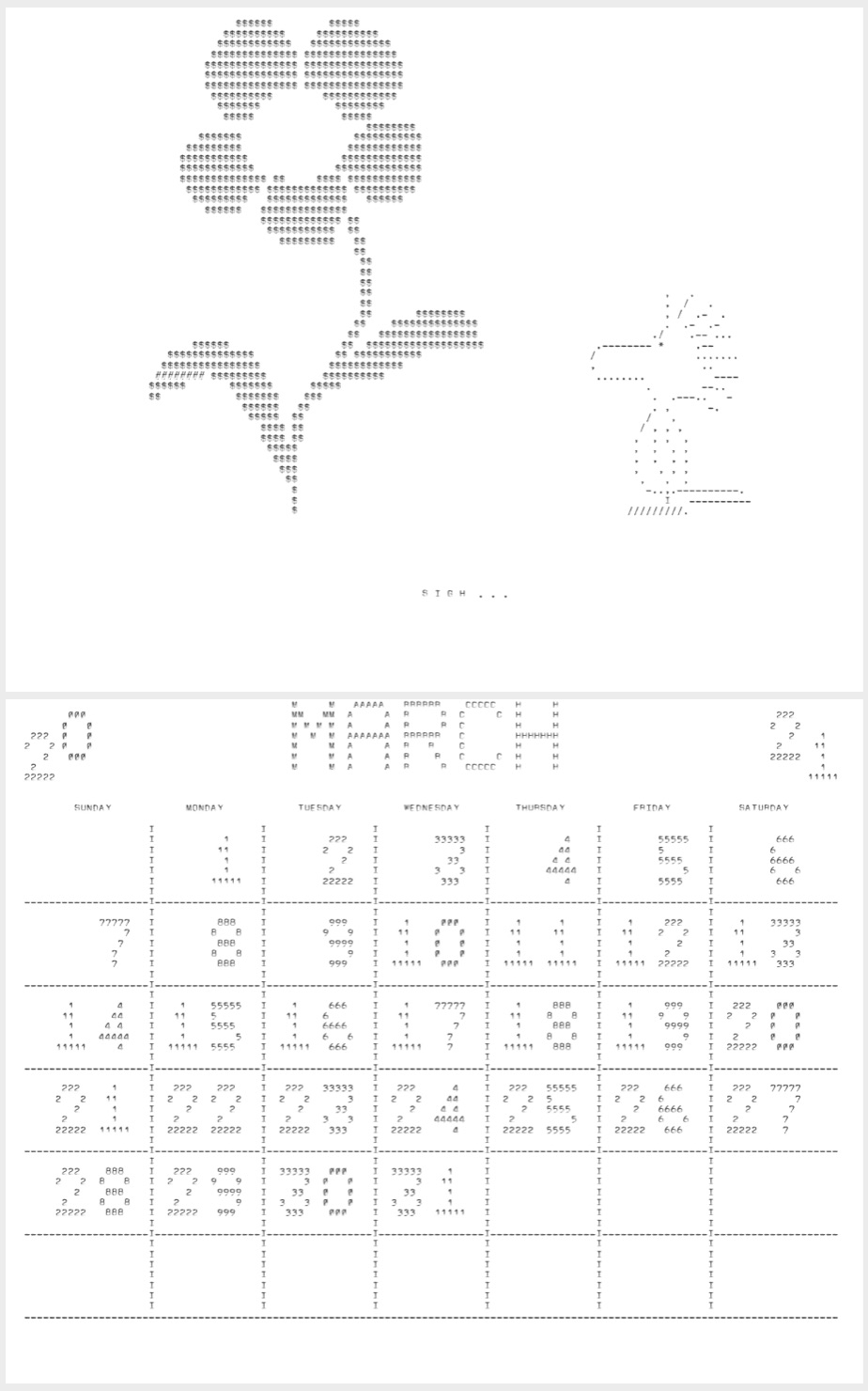
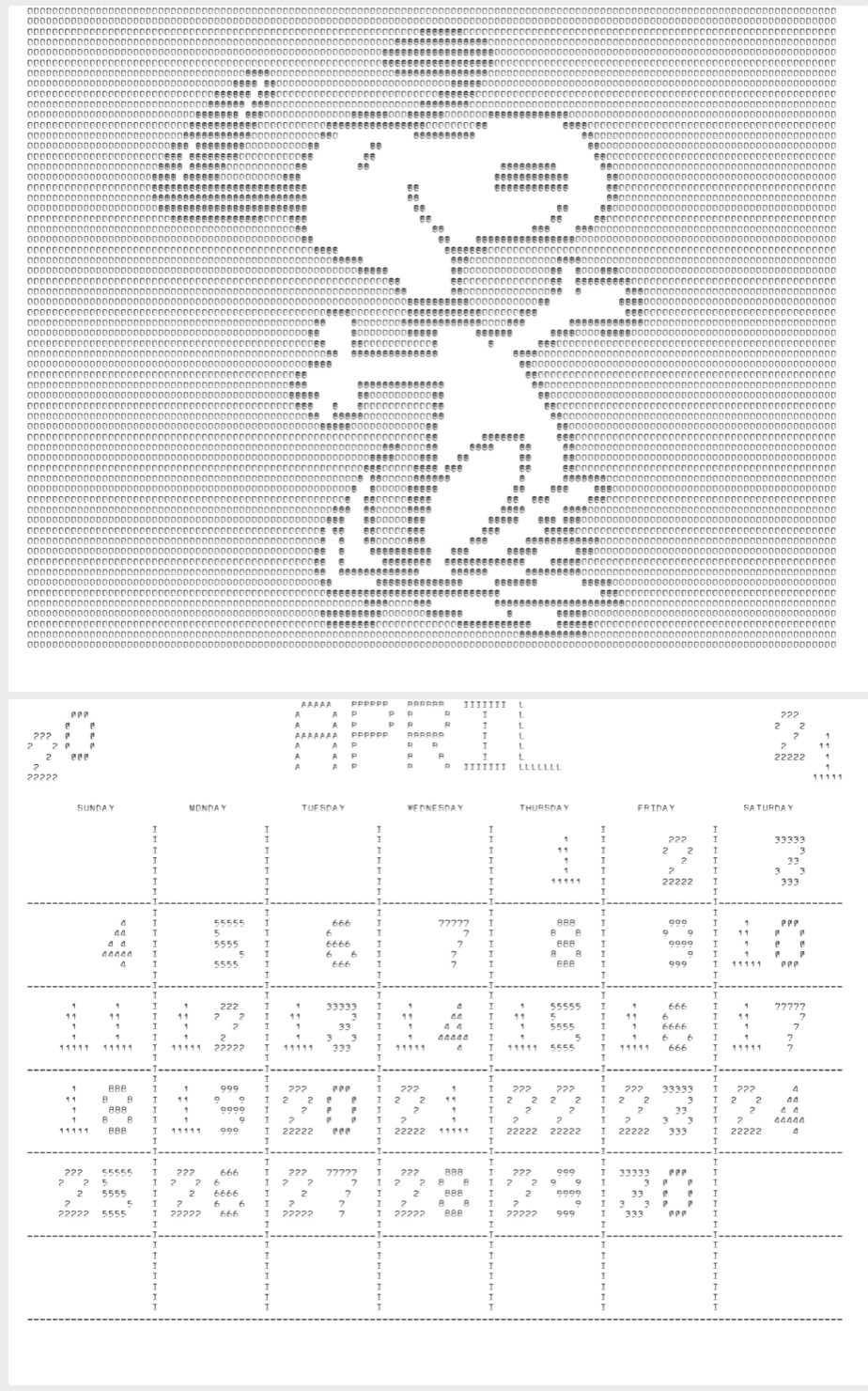
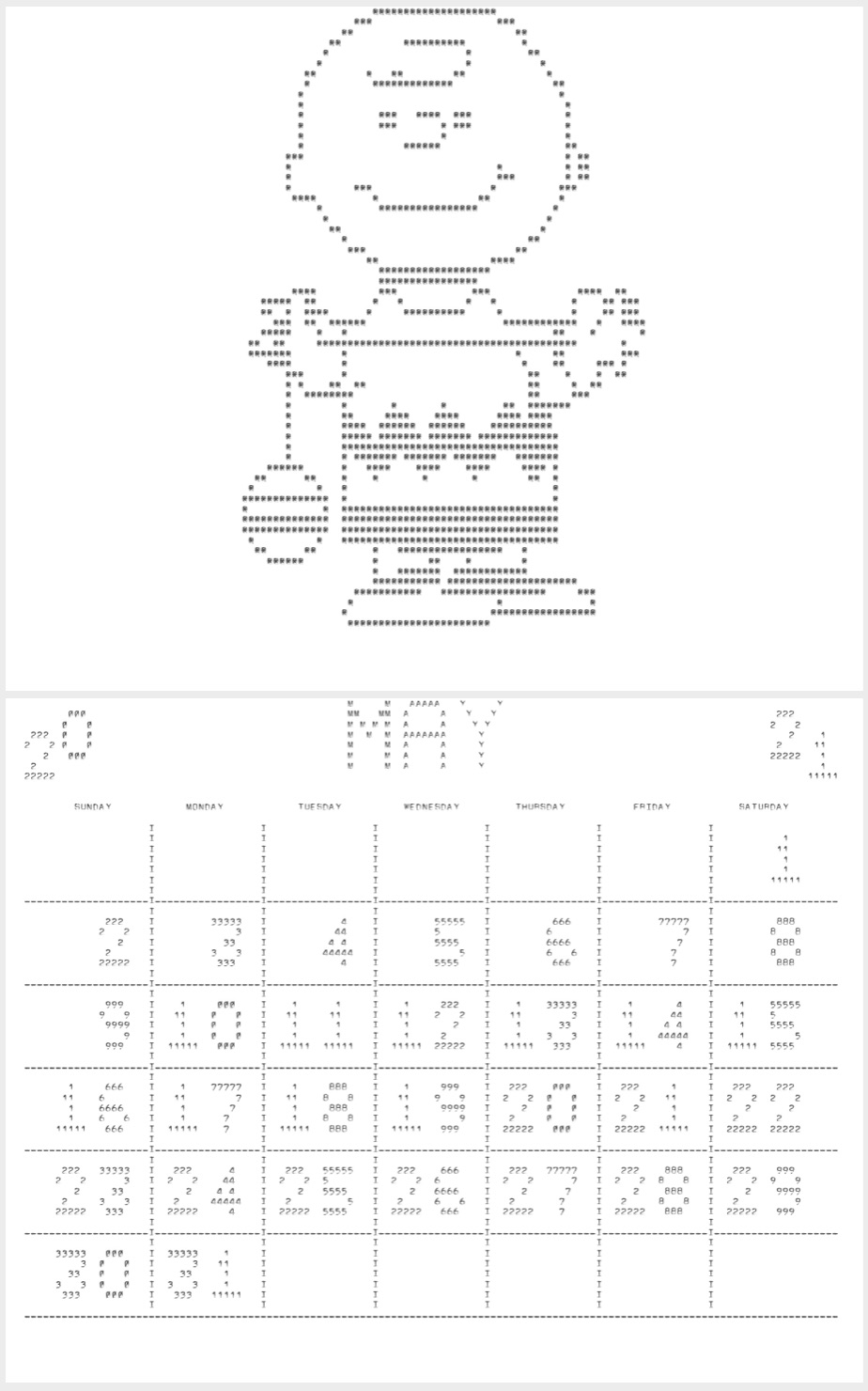
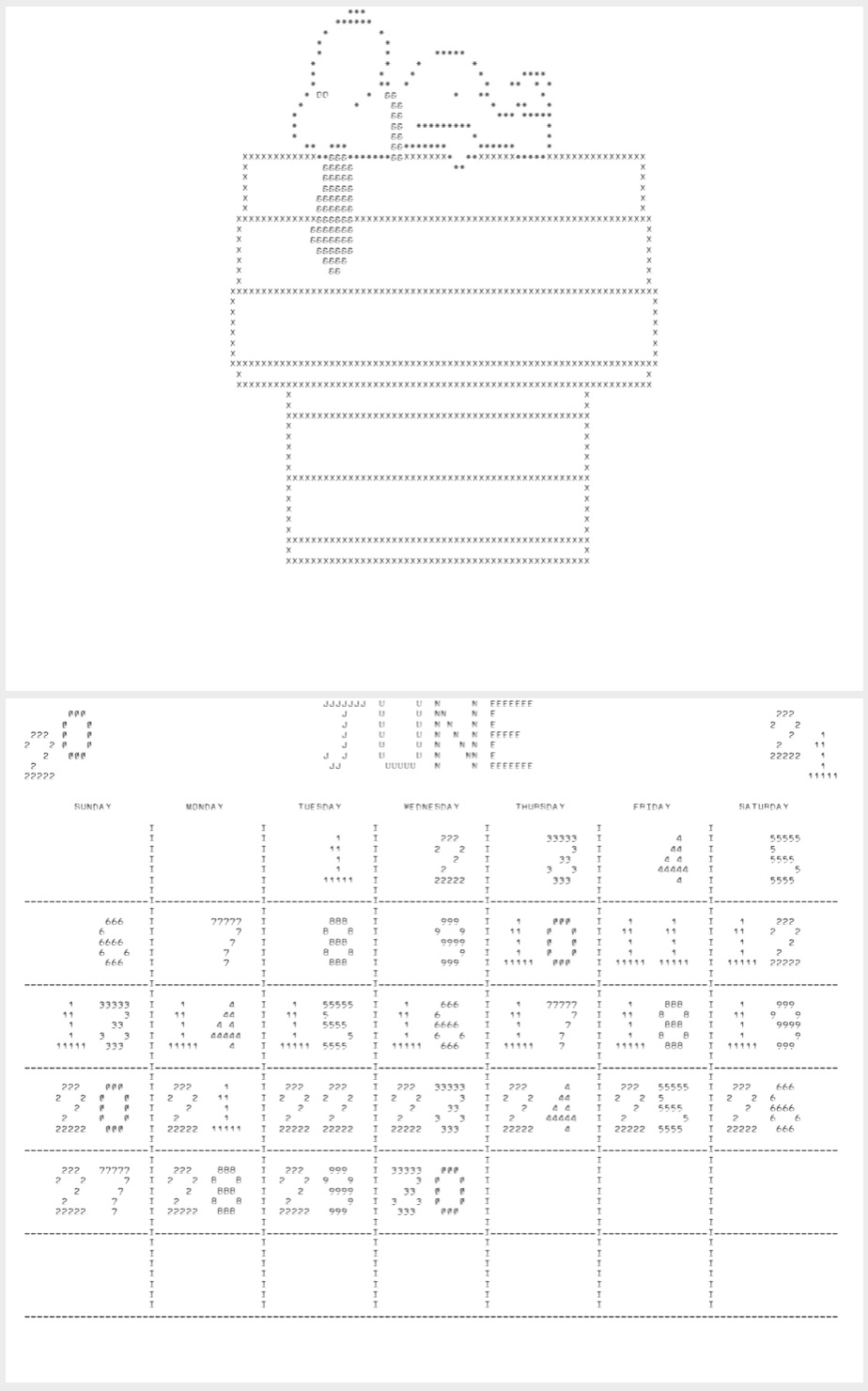
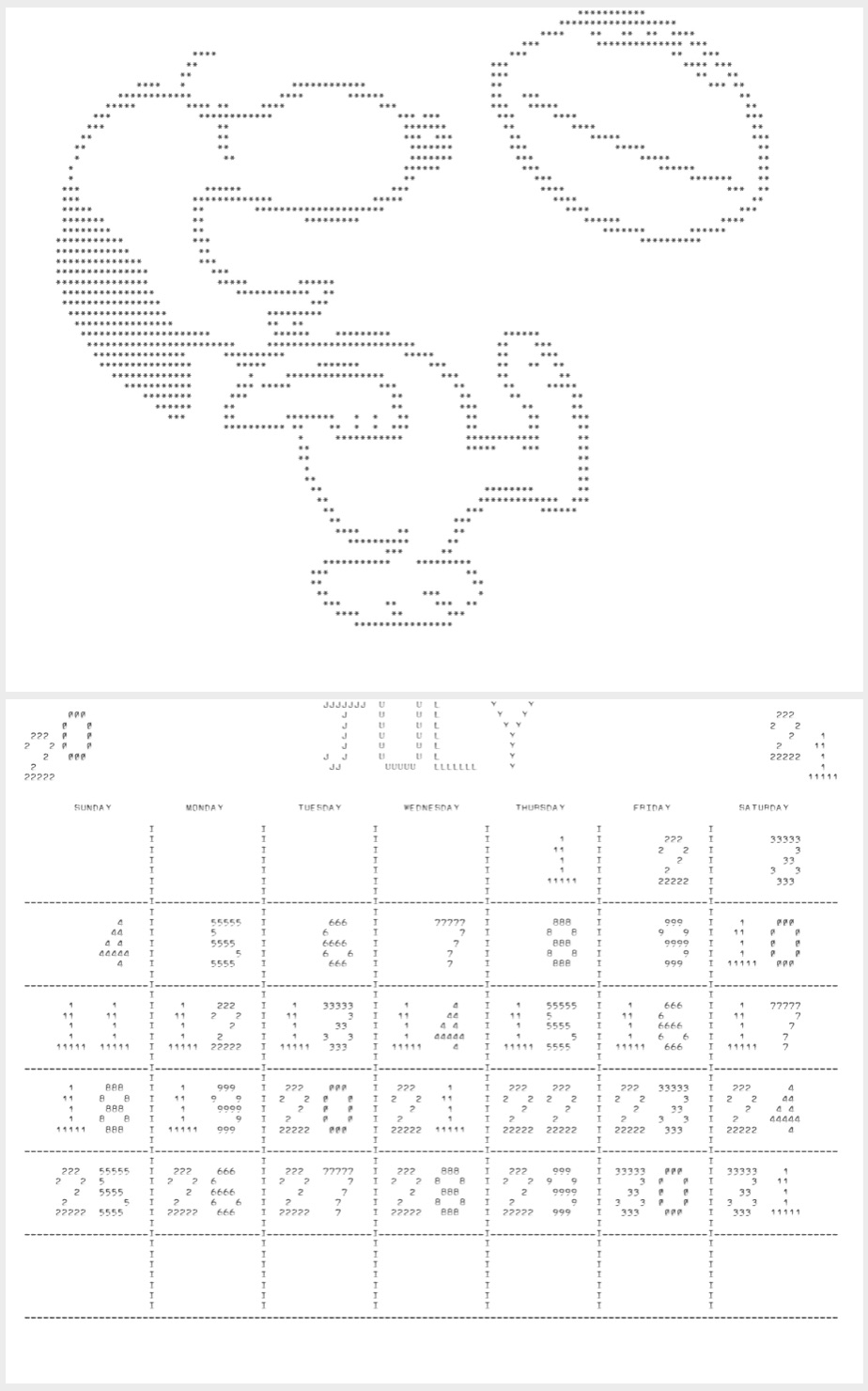
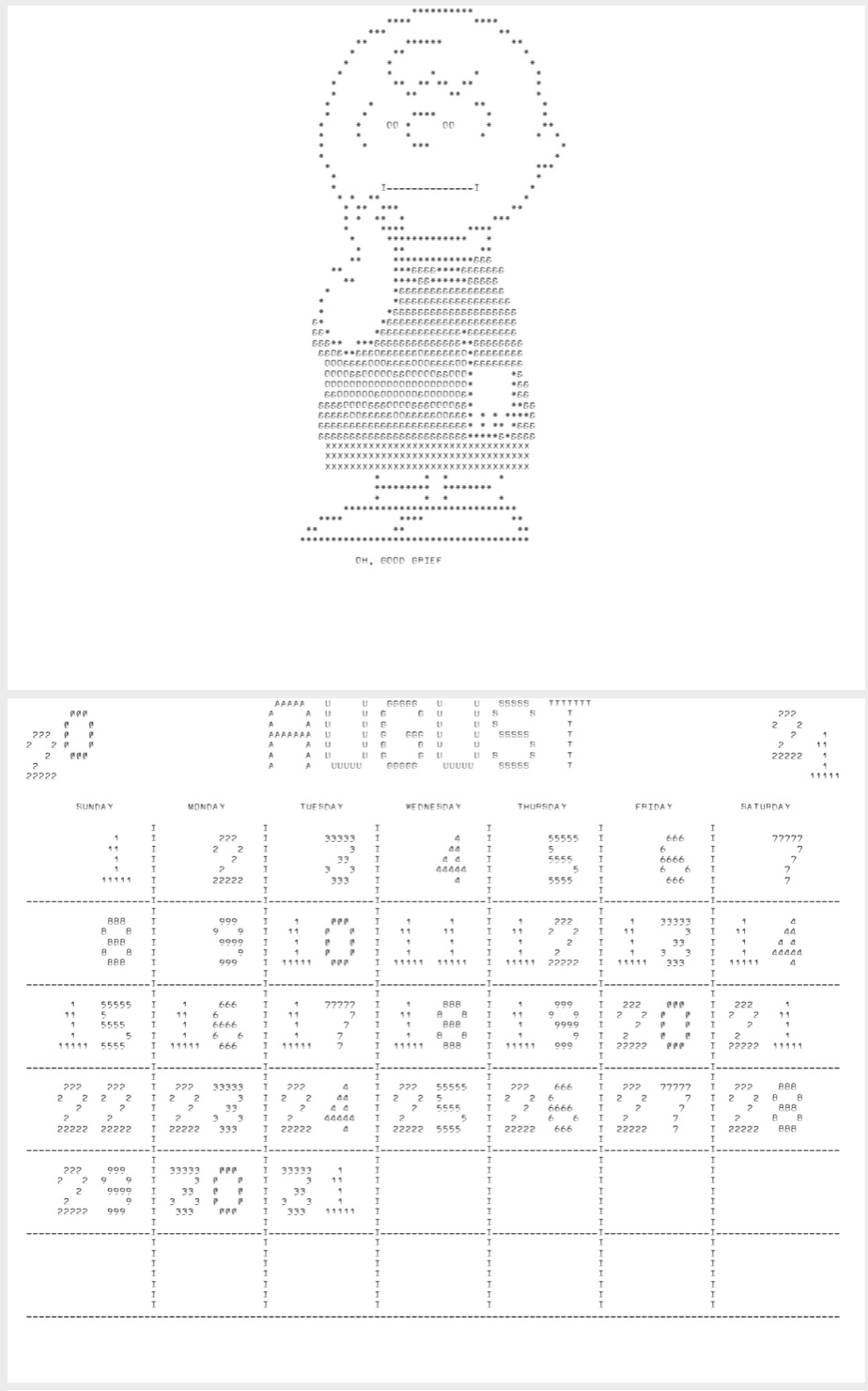
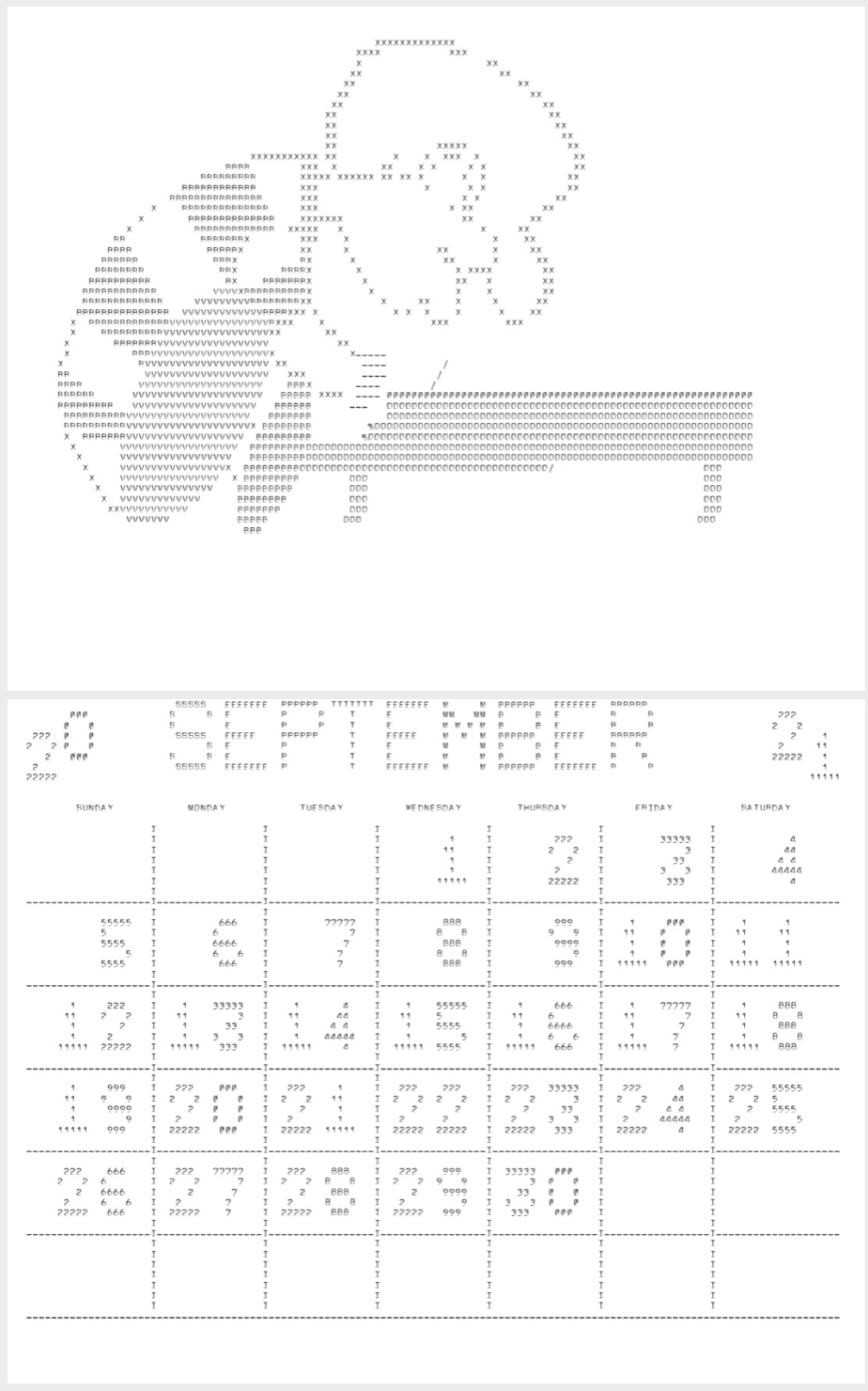
Several of the images use type overstriking, which is clearly superior to other forms of ASCII art.
Year calendar
I wrote a short script to generate a year calendar using the commands cal and figlet and one of the SNPCAL images. In a shortsighted development, modern distributions of cal only generate 80-column output, so I reformatted the text for a wider 132-column structure with a few bash script gymnastics.
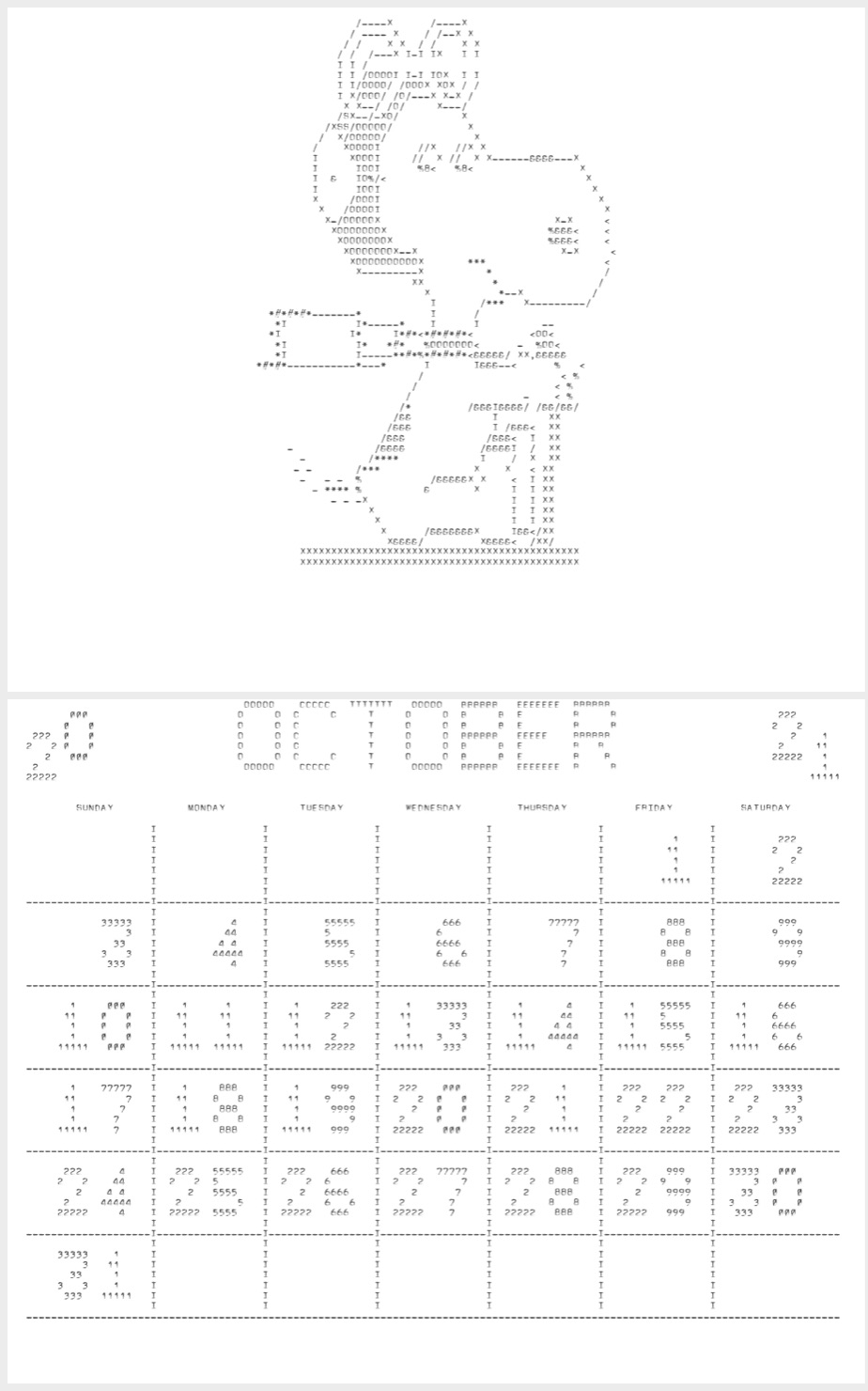
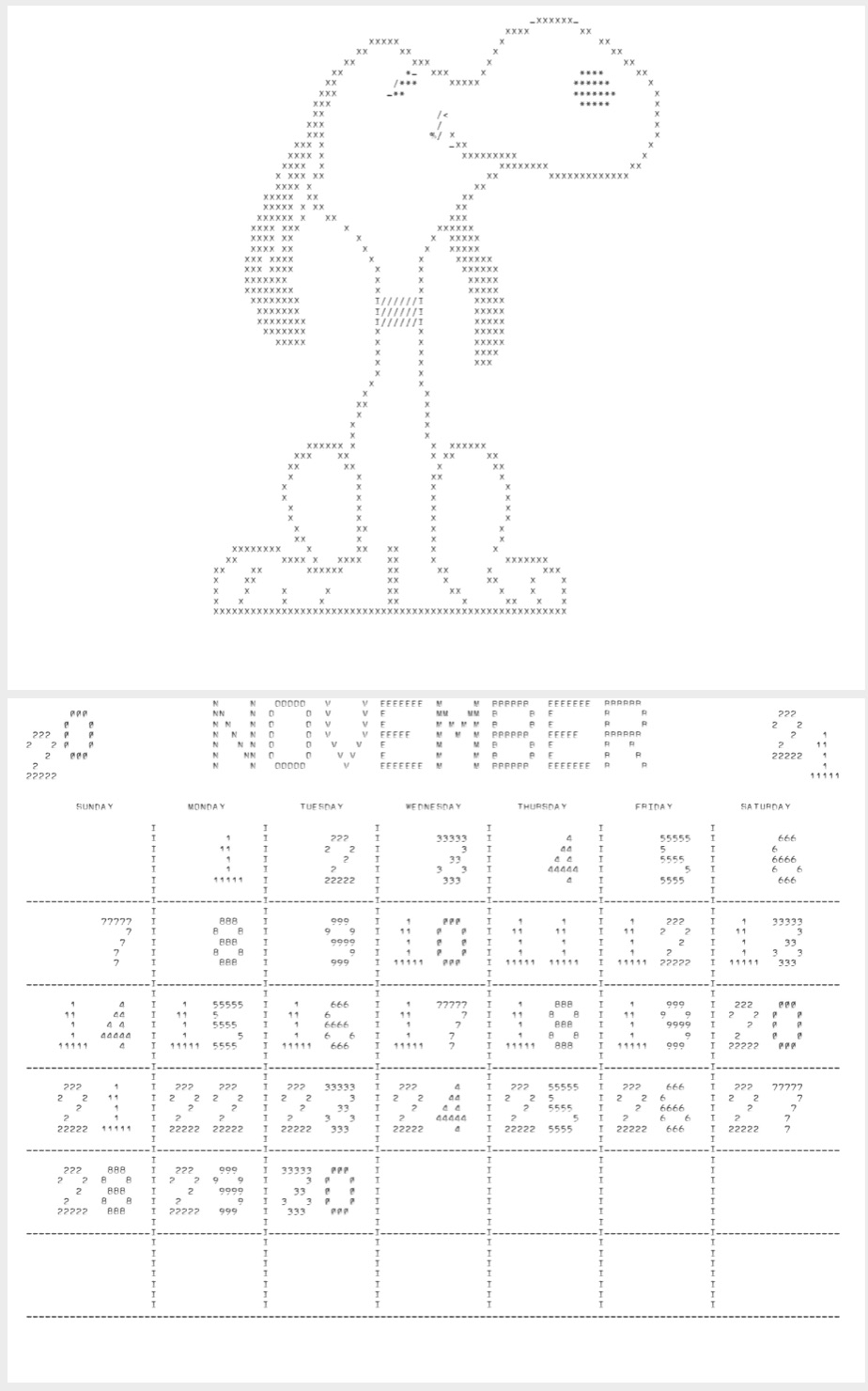
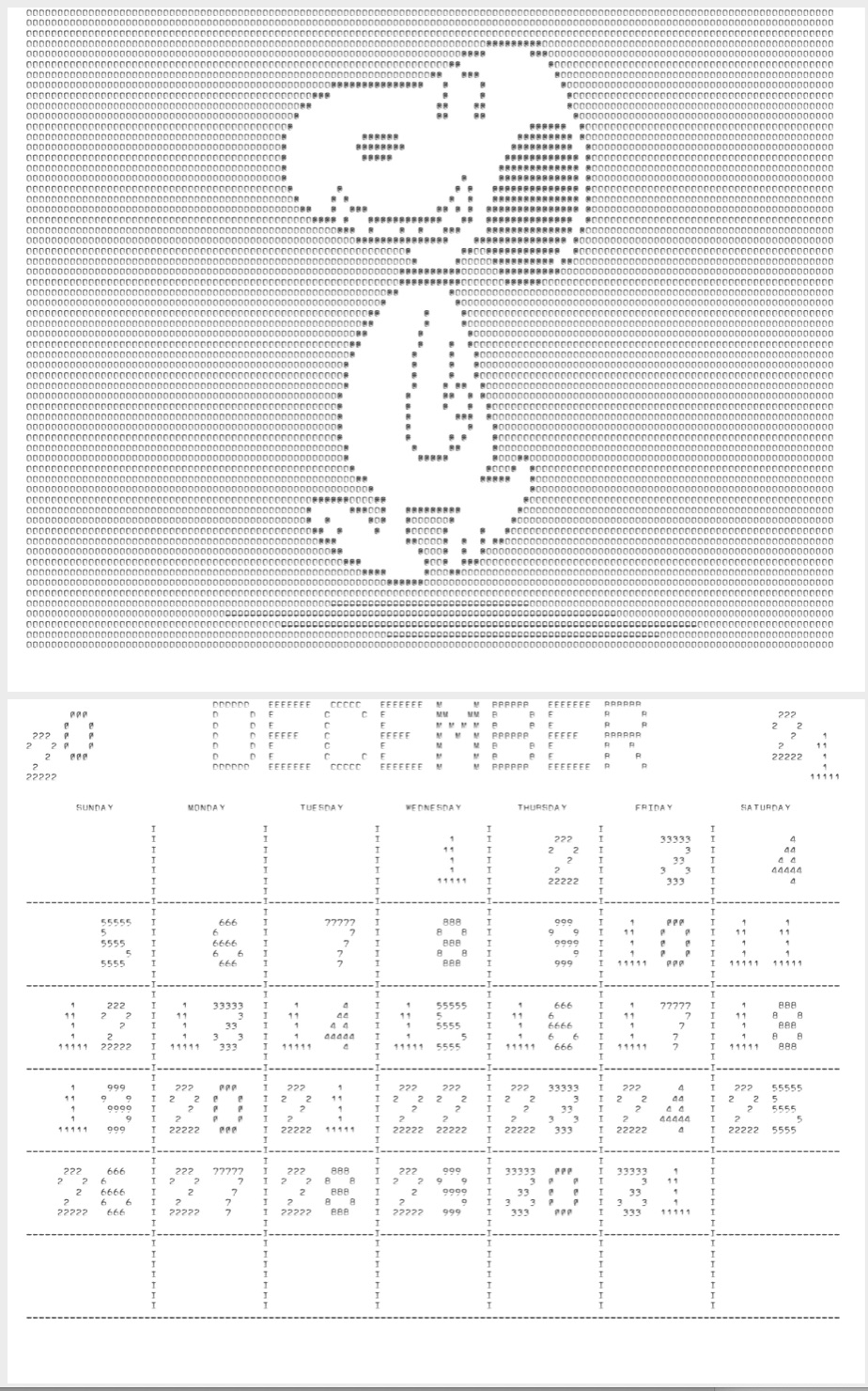
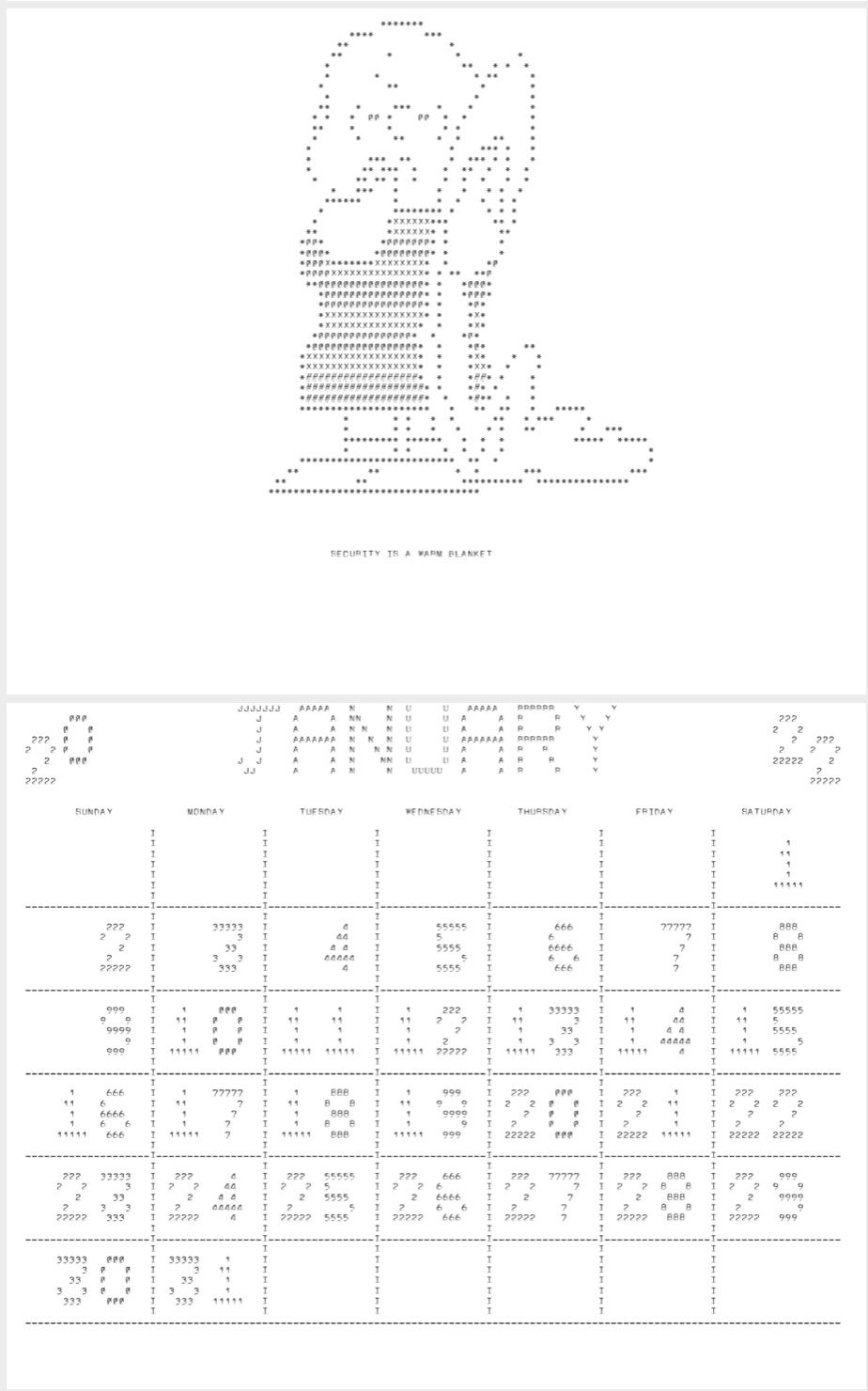
Here's a printed calendar; worthy, I think, of a Real Programmer's wall.
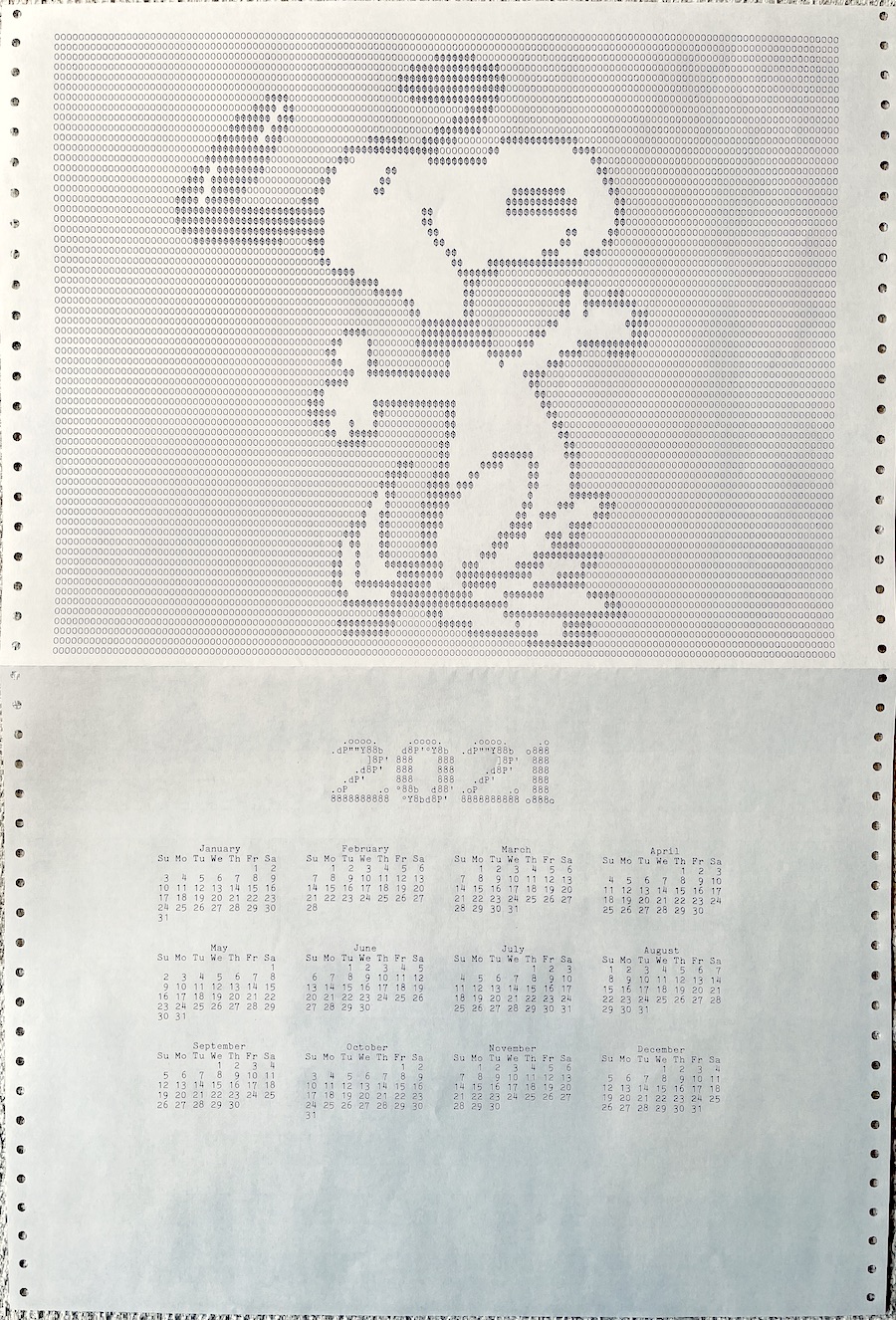
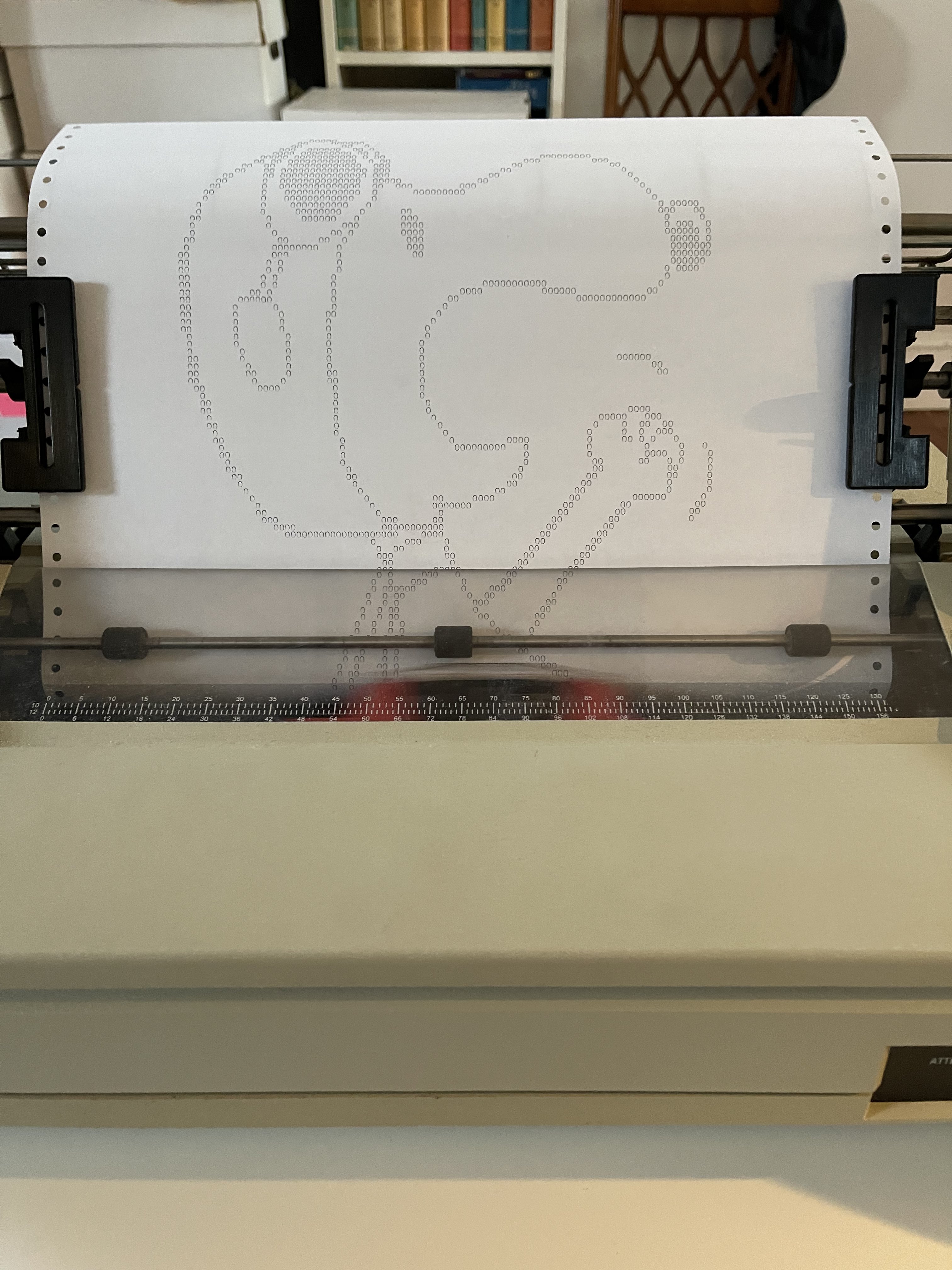
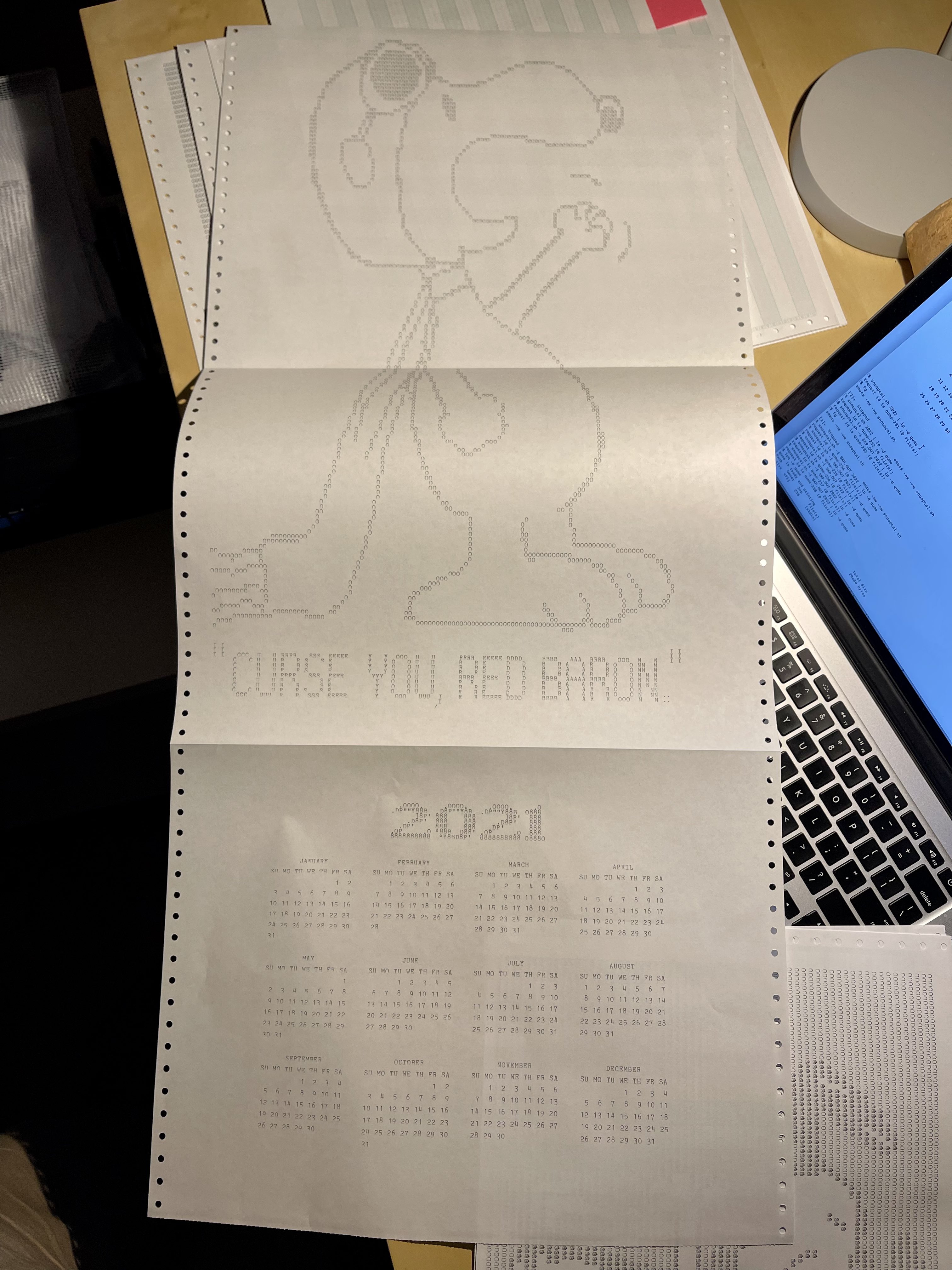
The calendar is printed with a daisywheel printer (Qume Sprint 11/55) to mimic the impact printers used in computer centers in the 60's and 70's, such as the IBM 1403. Impact printers enable overstriking – printing glyphs on top of each other by issuing a carriage return without a line feed. The paper is green-bar Universal UNV15852 Computer Paper, 20lb, 14-7/8” x 11”, perforated, using the blank side, similar to surviving examples from the 1970's. And, in a fit of late-night artisanal ASCII art crafting by hand, I produced this realization of the historical calendar, "Curse you, Red Baron 2021."
Program files
Compile with f77 -fdec snpcal.for snppic.for -o snpcal using GNU fortran. The source has instructions for editing snpcal.dat to change the range of months or the year. The DECUS FORTRAN file refers to a "non-working IBM Fortran + BAL version." BAL is the IBM Basic Assembler Language. Of course a Real Programmer is going to make their Snoopy calendar in assembler! C'mon!
| File | Type | Size | Description |
|---|---|---|---|
| snpcal.for | TXT | 14K | Snoopy calendar FORTRAN code |
| snppic.for | TXT | 1K | Snoopy calendar picture generator |
| snpcal.dat | TXT | 37K | Snoopy calendar data file |
| genpic.f | TXT | 3.4K | Hack to generate pictures from data file |
| curb.txt | TXT | 12K | Curse you, Red Baron! |
Links and media
- Aleator Press - Snoopy calendars as the "canonical example of `computer crime',” James Ryan, 2021.
- Adafruit Industries Blog - 2022 Line-Printer Snoopy Calendar #Art #VintageComputing @aleatorpress @ef1j95, Anne Barela, December 9, 2021.
Computer crime
James Ryan of Aleator Press, writes [1] that the (unauthorized) use of line printers and their associated computer equipment to generate ASCII art (such as calendars) was cited as a "canonical example" of "computer crime." In the late 1970's, proposed legislation in Congress [2] would have made printing such calendars a federal felony punishable by 15 years in prison or a fine of two and one-half times the amount stolen, or both. (The bill limited the judge's sentencing discretion to a formula of plus or minus twenty-five percent. A Real Programmer's sentence would have to be between eleven years and nineteen years for the crime of printing a Snoopy calendar.)
As Ryan points out, John K. Taber published a fascinating and detailed critique of Senate bill S.240 [3] that includes Congressional testimony with the then junior Senator from Delaware, Joseph R. Biden. Taber quotes this exchange:
But why was the Snoopy line printer calendar singled out?
Parker's testimony
The original reference to illicit line printer calendars comes from Donn B. Parker, who testified in support of S. 1766 [4], an earlier attempt at drafting computer crime legislation, at a subcommittee hearing chaired by Senator Biden. Parker, then an employee of Stanford Research Institute (SRI), was an early expert on "computer abuse," a term which he coined, and author of the 1976 book Crime by Computer. [5] His written and oral testimony states,
Parker was serious about sending a strong message to the computing community. He clearly saw these widespread practices as a problems of great concern. He testified to the Subcommittee,
His testimony continued, returning to the practices of playing games, printing calendars, and using the computer for personal data,
It is shockingly harsh when read today. Perhaps Parker was drawing from frustrating experiences as a computer center manager when he railed against Snoopy calendars, playing games, and writing programs that keep track of bowling scores and church mailing lists. Computer time was expensive throughout much of his career, but by the end of the decade it was decreasing at a rapid clip, especially with the advent of commercial timeshare systems and personal computers. [6]
Trojan horses and salami
Parker certainly captured imaginations with his book and testimony describing trojan horses, logic bombs, electronic break-ins (more primitive than what was later popularized in the movie War Games), corporate espionage, stealing programs, willful destruction of computer systems, and "salami slicing." [7] The latter is a prominent example in Parker's testimony. It is a "rounding crime" that steals small amounts from a large number of bank accounts and deposits them into the perpetrator's. According to Parker,
He talked to some of his friends who also have accounts in this bank. The bank has about 300,000 checking accounts.
They also reported finding 12 to 25 cents missing several times a year from their checking accounts.
The bank has a policy of paying off any small discrepancies under $2. There are no questions asked. So he went to the bank and complained about this. They said, "well, you have your 18 cents back, what are you worried about?" He said , "No, no, no. That's not the problem. I I think you have a salami in there." They said, "A salami? " [Laughter.] turns out he is a programer, so he understood some of these things. He explained what was going on, and the auditors looked at the situation. As I understand it, the FBI was called in, the Comptroller of the Currency, and the bank examiner looked at it. Everybody agreed that it is possible that there was a salami in there.
However, the bank said that they were only losing a few hundred dollars a year in paying people back. Most people do not even complain about 12- or 18- cent discrepancies. So, they had very few complaints about it.
There is no documentary proof, no forensic audit, no prosecution, and no confirmed victimization in Parker's account before the Senate subcommittee. As John Taber points out, Parker's analysis throughout the hearing and his earlier book relied on weak or circumstantial evidence -- "The SRI study is unreliable because it is based on poor documentation, unacceptable methods, and unverified (indeed unverifiable) losses." [8] Taber also notes that the possibility of round-off fraud was well-known long before computers, and "...is so well guarded against, that it was, and is, practically impossible to successfully perform." Much of what Parker has to say about it is apocryphal.
In the end, Donn Parker's forceful calls for severe punishment did not hold much sway. Most of the June 1978 hearing participants, lawmakers and witnesses alike, balked at taking a hard line against seemingly innocuous "theft" of computer time as printing a Snoopy calendar. Biden, especially, was clearly concerned with the potential for Federal prosecutors and law enforcement to abuse the broad legislation presented in S. 1766, and later, S. 240.
Instead, the lawmakers and representatives from the Department of Justice and FBI were more interested in white collar crime committed with the aid of a computer -- embezzlement, fraud, and larceny. This is hardly surprising given that the bill's author, Senator Abraham Ribicoff, represented Connecticut, a state with a large presence of insurance companies and banks. Parker's own testimony relied heavily on three fraud cases, including one dealing with the Equity Funding Corporation, where computers were used to create thousands of fake insurance policies. In this case, like others cited at the hearing, the computer was simply a tool that allowed a crime to be committed at an unprecedented scale compared to older business processes that relied on painstakingly slow paperwork.
The 1978 hearing captures debate over how to limit sentencing or establish misdemeanors for acts like printing a Snoopy calendar, but ultimately the lawmakers could not come to a resolution. Taber summarizes the issues in his critique of S. 240,
Taber concludes that S. 240 could never be equitably enforced under the circumstances.
Title 18 U.S. Code § 1030
The early attempts at computer crime legislation in S. 1766 and S. 240 are interesting from other perspectives. The participants grappled with what it means to "intrude" electronically through unauthorized access, what the theft of information actually means without being a real, tangible entity, like a tape, disk, or set of punch cards, and the potential threats to personal privacy. (The latter concern is particularly ironic in our time of scraped and highly-trafficked personal information in today's surveillance-powered commercial internet.)
Susan H. Nycum, a lawyer and collaborator of Parker's, describes an experience that got her interested in computer crime law,
While the attempt to destroy the computer center's system records was stymied, Nycum followed up with local law enforcement only to be told that even if officers could witness the crime occurring, the charge would be for the placing an obscene or harassing telephone call, a misdemeanor offense.
Snoopy calendars and Star Trek games aside, the central problem confronting computer crime enforcement was that unauthorized access, if illegal at all, could only be pursued through a patchwork of pre-existing statutes never designed for electronic intrusion. U.S. Attorney Jervis Finney testified that, "As the United States Attorney's Office in the District of Maryland has discovered, crimes involving computers can be prosecuted only through an imaginative use of the somewhat antiquated statutes which presently exist." He was referring to the case of the United States of America v. Bertram Seidlitz, who was accused of accessing his former employer's computer remotely to steal information. [9] Because Seidlitz used a computer terminal in his Alexandria, Virginia office to access a computer in Maryland, he was prosecuted under the wire fraud statute (Title 18, United States Code, Section 1343).
Eventually, issues like these became the primary focus of legislation that did pass in 1984 to create Title 18 U.S. Code section 1030 -- Fraud and related activity in connection with computers. William Morris was the first to receive a felony conviction under that Act for releasing the worm that took down a good part of the nascent internet in 1988. [10]
Conclusion
The history of the Snoopy calendar in the annals of computer crime legislation captures a tension in early computing culture: the collision between creative, exploratory use and a legal framework grounded potentially in scarcity and control. Hacker and programmer cultures celebrated whimsy, ingenuity, and humor, treating computers not merely as instruments of production but as sites of play, expression, and creative repurposing. [11] John Taber articulated what was at stake if unauthorized computer use were criminalized indiscriminately, warning that a fifteen-year prison sentence would erase an entire culture of experimentation rather than deter genuine wrongdoing:
Donn Parker’s insistence that such activity be made illegal rested on an assumption increasingly out of step with reality -- that computers were scarce, centralized, and expensive assets requiring strict control. Even as these hearings were held, that assumption was already eroding. The microcomputer revolution was being born, and within a few years personal computers would proliferate into businesses and households nationwide. Over four decades later, we often carry multiple computers with us, incomparably more powerful than the mainframe computers of the 1970s, and interact with them by the minute (perhaps to our own detriment). [12]
The line printer Snoopy calendar stands as both an emblem of the programmer's ethos [13] and, paradoxically, as one of the canonical examples invoked in the early debates on computer crime.
...
References
- Aleator Press. Snoopy Calendar 2022. Accessed January 4, 2026. https://www.aleator.press/shop/p/snoopy-calendar-2022.
- United States. Congress. Senate. Committee on the Judiciary. Subcommittee on Criminal Justice. Computer Systems Protection Act of 1979, S. 240: Hearing Before the Subcommittee On Criminal Justice of the Committee On the Judiciary, United States Senate, Ninety-sixth Congress, Second Session, On S. 240, February 28, 1980. Washington: U.S. G.P.O., 19801981.
- Taber, John K. On Computer Crime (Senate Bill S. 240), 1 Computer L.J. 517 (1978), link
- United States. Congress. Senate. Committee on the Judiciary. Subcommittee on Criminal Laws and Procedures. Federal Computer Systems Protection Act: Hearings Before the Subcommittee On Criminal Laws And Procedures of the Committee On the Judiciary, United States Senate, Ninety-fifth Congress, Second Session, On S. 1766, June 21 And 22, 1978. Washington: U.S. Govt. Print. Off. , 1979.
- Parker, Donn B. Crime by Computer. New York: Charles Scribner’s Sons, 1976.
- From this point on in the S. 1766 hearing, Snoopy shows up a few dozen times. It was used as a shorthand for unauthorized but minor activities by computer users and computer center staff. Taber writes this in his article on S. 240: The choice of Snoopy calendars as the generic example for this type of "playing around" is due to Donn Parker of SRI, and is poorly chosen. Years ago, Charles Schulz' attorneys requested that the industry stop the making of Snoopy calendars, because the practice infringed on Mr. Schulz' copyrights. Management agreed, and suppressed the practice. The author has not personally seen an illicit Snoopy calendar since about 1970. All participants in discussions on the computer crime bill should refrain from using this example so as to avoid unnecessarily alarming Mr. Schulz. If a generic term is needed, such items as tic-tac-toe, or the contemporary rage "Adventure," written by computer scientists at MIT and Stanford's artificial intelligence laboratory, could be used.
- Gerald Jonas writes in the New York Times, "Parker is no Erle Stanley Gardner [author of the Perry Mason series], and his style sometimes resembles that of an intelligent computer trying to convince its programmer that it speaks English... But the material itself is fascinating." Jonas, Gerald, New York Times, p. 219, June 13, 1976.
- Taber, John K. A Survey of Computer Crime Studies, 2 Computer L.J. 275 (1980).
- Seidlitz was convicted in the U.S. District Court for the District of Maryland on two counts of wire fraud, a judgment affirmed on appeal. United States of America, Appellee, v. Bertram E. Seidlitz, Appellant, 589 F.2d 152 (4th Cir. 1978). See also: United Press International. “Theft by Computer: Programmer Taps U.S. Data Secrets.” The New York Times, 17 June 1976, p. 58. Related to the Seidlitz case, courts and lawmakers struggled with the concept of stealing information. Laws at the time were generally thought to apply only to tangible things, like paper, not the information printed on it or when information was transmitted by electromagnetic impulses, unless it happened to be protected by trademark or copyright. Moreover, merely copying information did not deprive the owner of their "property." Further complicating matters, if information was indeed an asset, then lawmakers wondered if it could be taxed, too!
- United States v. Morris (1991), 928 F.2d 504 (2d Cir. 1991), decided March 7, 1991. See also: Hafner, Katie and Markoff, John. Cyberpunk: Outlaws and Hackers on the Computer Frontier. New York: Simon and Schuster, 1995.
- For example, see Rankin, Joy Lisi. A People’s History of Computing in the United States. Cambridge, MA: Harvard University Press, 2018; Levy, Steven. Hackers: Heroes of the Computer Revolution. Garden City, NY: Anchor Press/Doubleday, 1984; Raymond, Eric S., ed. The Jargon File. Accessed January 6, 2026. http://www.catb.org/jargon/
- Reading early accounts of computer crime legislation, one gains a greater appreciation for the deep, latent interest in microcomputers that rapidly drove the expansion of that market after the introduction of the Altair 8800 in 1975. (See, for instance, Freiberger, Paul and Swaine, Michael, Fire in the Valley: The Making of The Personal Computer. 2nd ed., New York: McGraw-Hill, 2000.) Owning such a "hobby computer," which cost as much as a car at the time, freed programmers from the tangle of unauthorized use, even if it was generally looked past or treated as a "fringe benefit." However, this had the reciprocal effect of making lawmakers and businesses fearful that the tools of computer crime would eventually become widely available, as discussed in the S. 1766 testimony of Robert Abbott.
- Ed Post, Real Programmers Don't Use PASCAL, Datamation, July, 263 (1983). achive.org link
Inspired by SNPCAL
August 2022
Oliver Wendell Jones was a Real Programmer.
Courier 10 typeface rendered on a wide format Qume Sprint 11/55 daisywheel printer on green-bar Universal UNV15852 Computer Paper, 20lb, 14-7/8” x 11”, perforated, using the blank side.
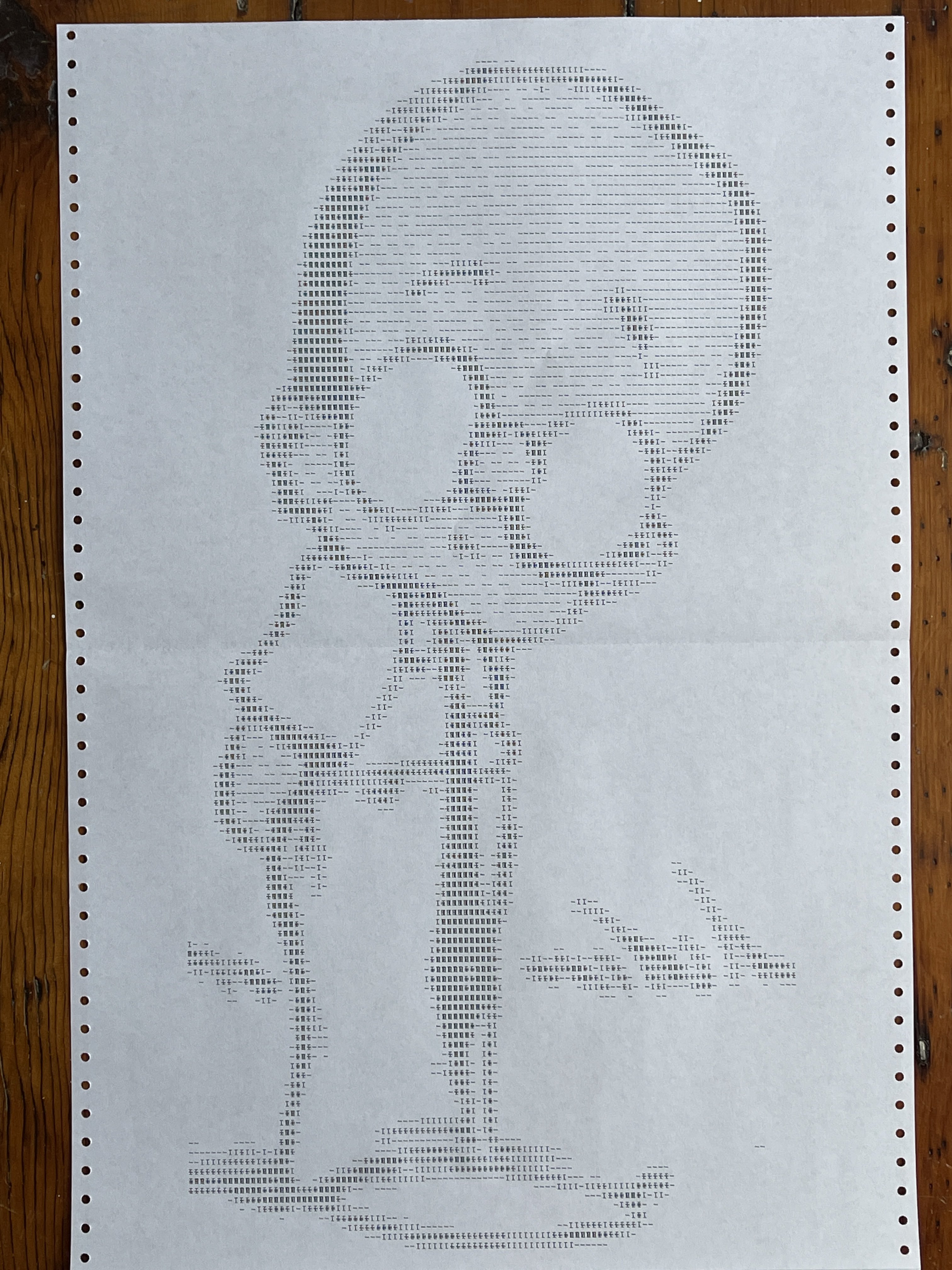
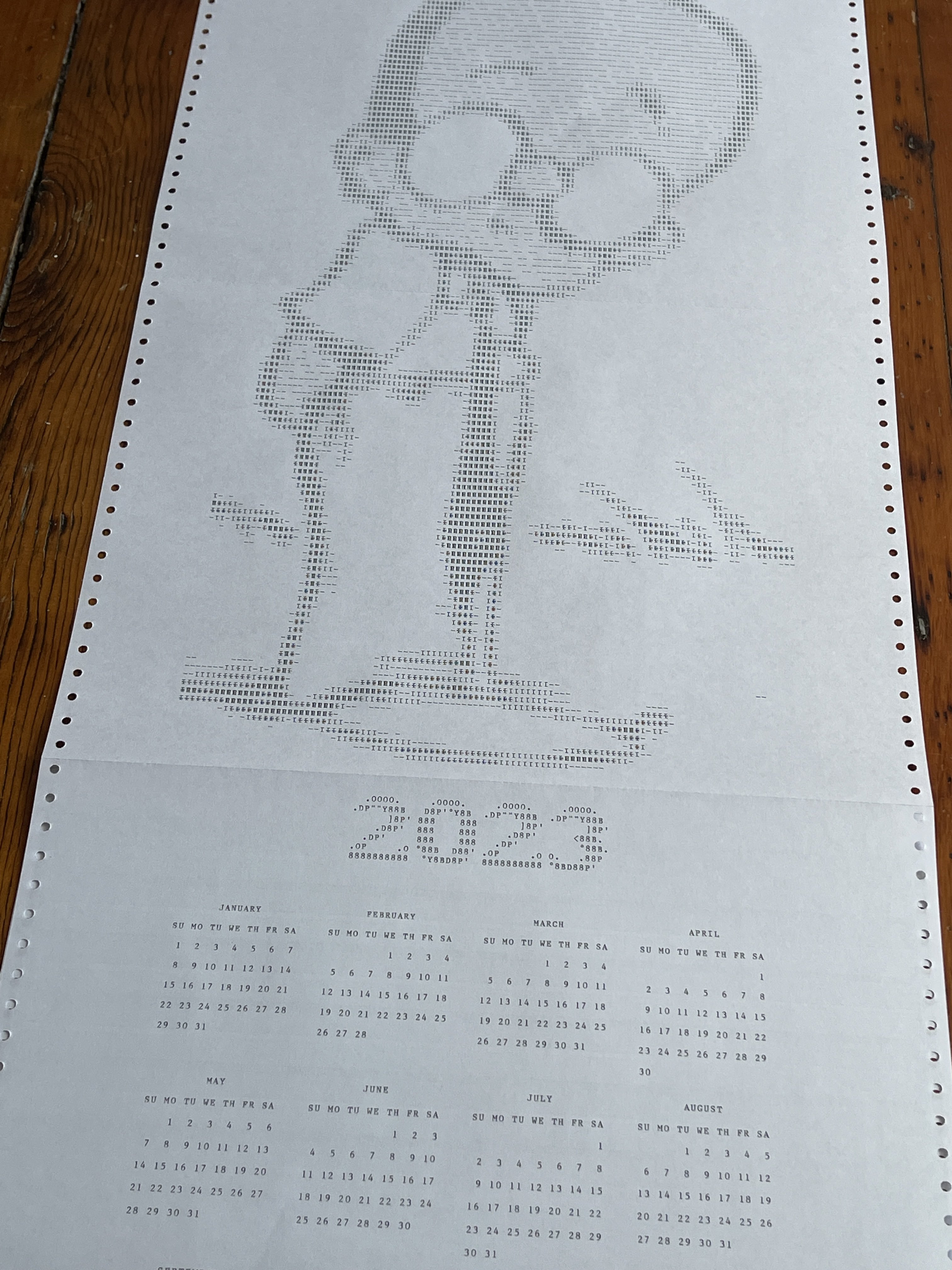
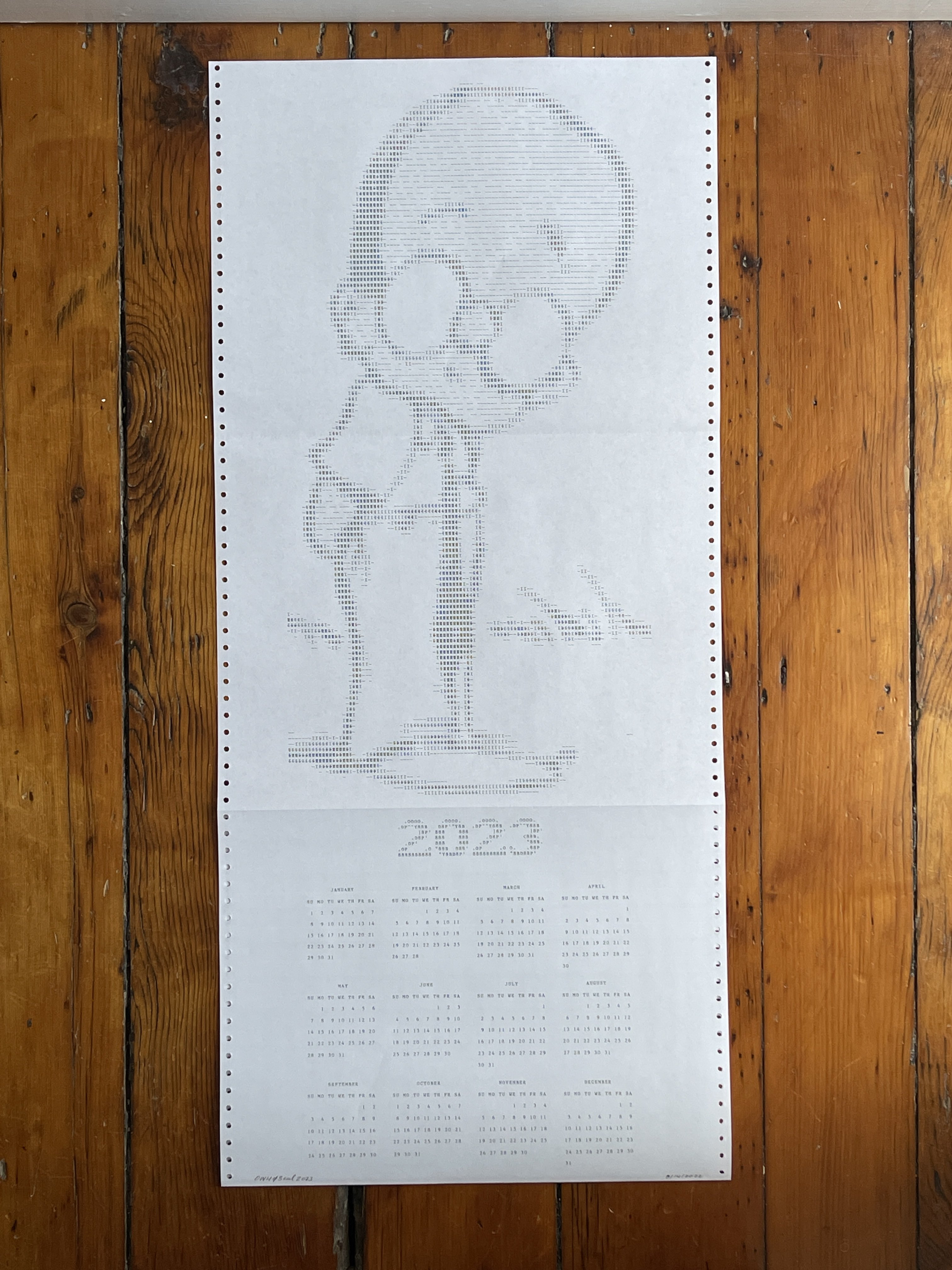
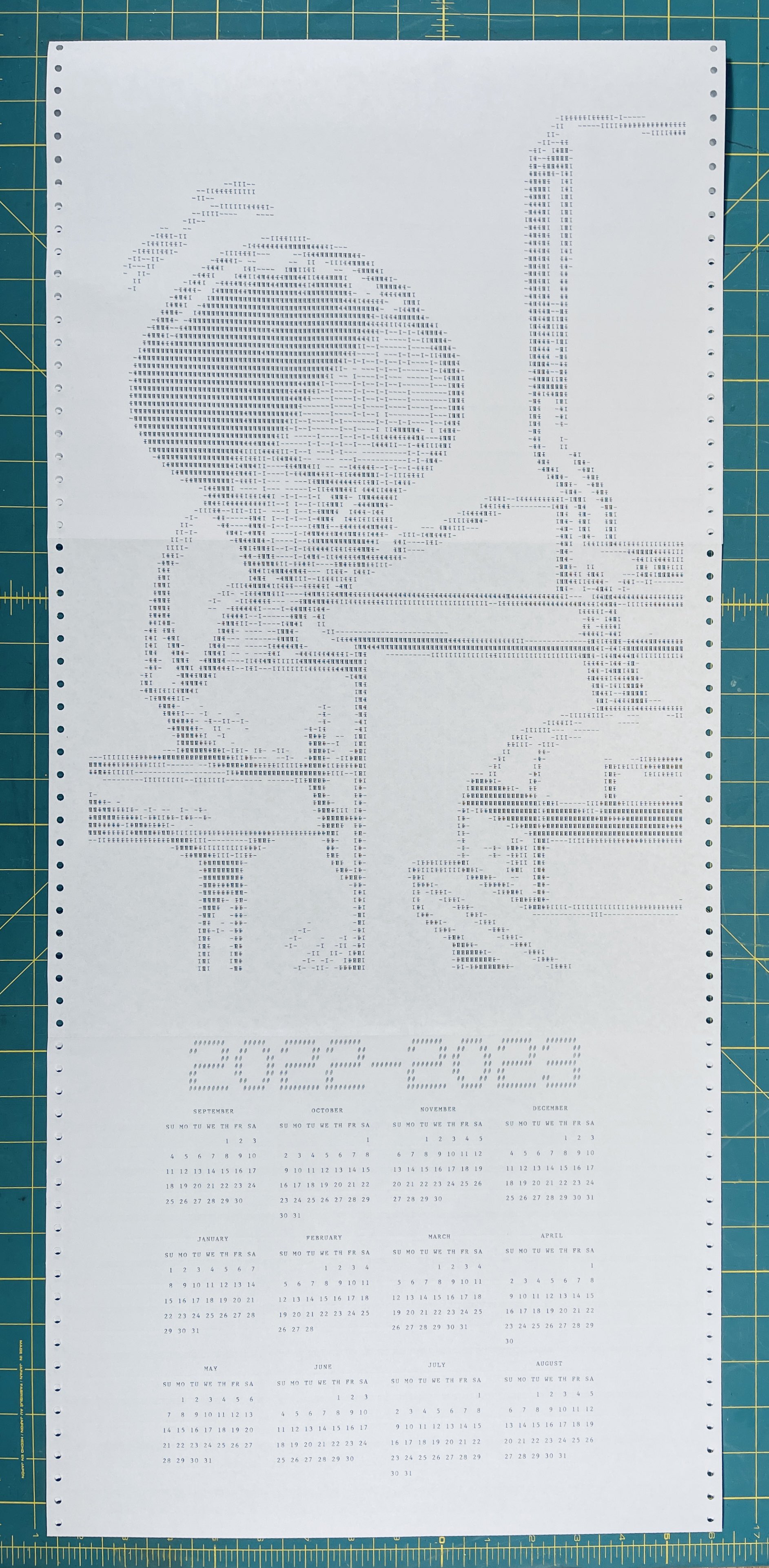
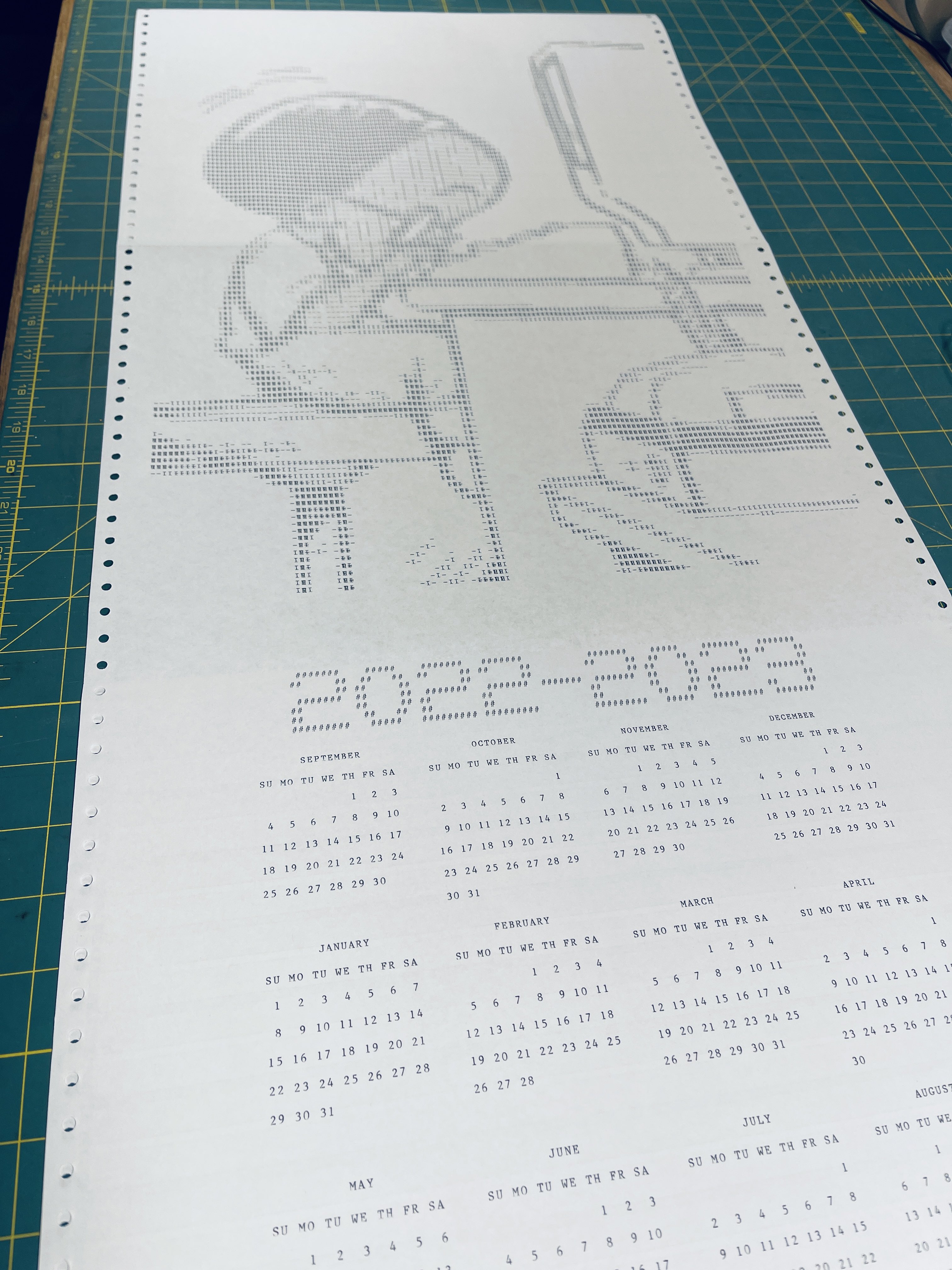
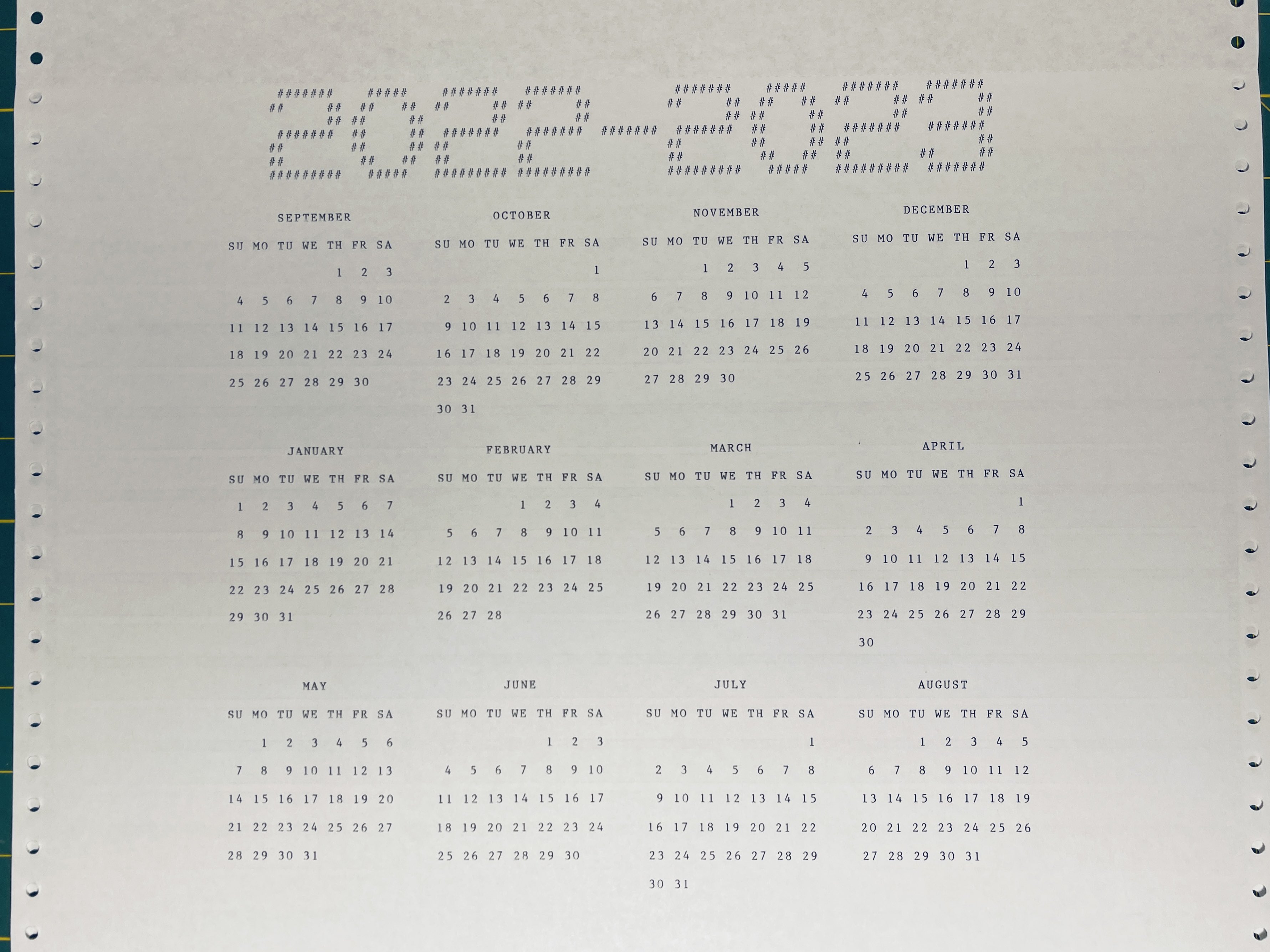
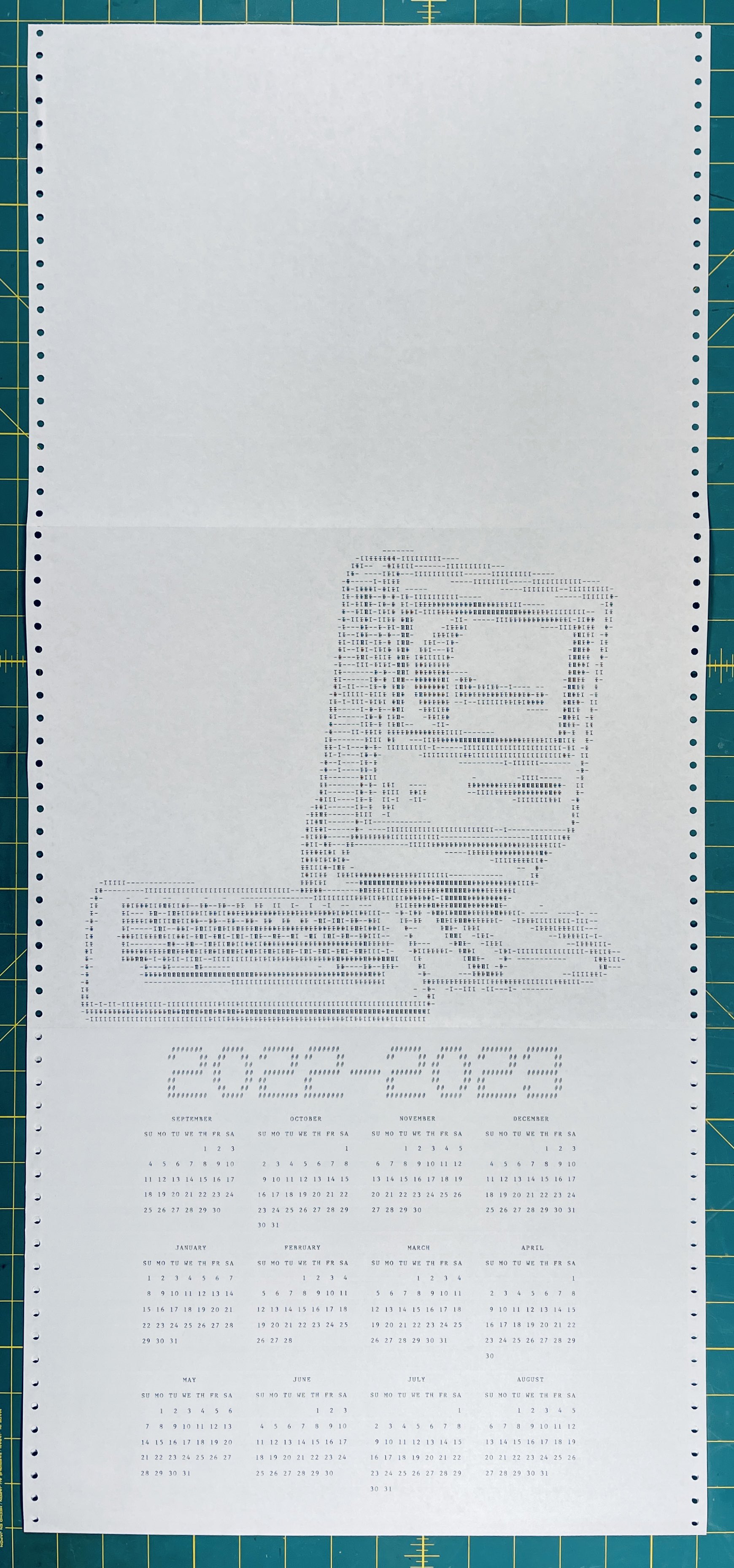
Bill the Cat and Opus are left as an exercise for the reader.
2023 calendars
Text file downloads to share on your favorite BBS.
| File | Type | Size | Description |
|---|---|---|---|
| OWJ03cal2023.txt | TXT | 39K | Oliver Wendell Jones 2023 |
| CURB2023.txt | TXT | 16K | Real Programmer 2023 |
2025 Cool Beagle
December 2024
A 2025 calendar series rendered on a wide format Printronix P300 line matrix printer. 14 7/8" x 11" 15 lb. tri-perforated continuous computer paper with green lines, printed on the blank side, 6 lines per inch, 132 columns.
* for the mega-rich!
The images are generated using text prompts to a popular large language model AI. The results are converted to text mode using custom scripts and merged with the output of a calendar-producing program. What fascinates me about the images is the way they hone in (with prompting) on a close resemblance of Snoopy from the comic strip Peanuts. However, even these versions have telltale signs of AI -- missing fingers, multiple renderings, and obfuscated signatures among them -- in addition to sudden diversions into entirely different styles.
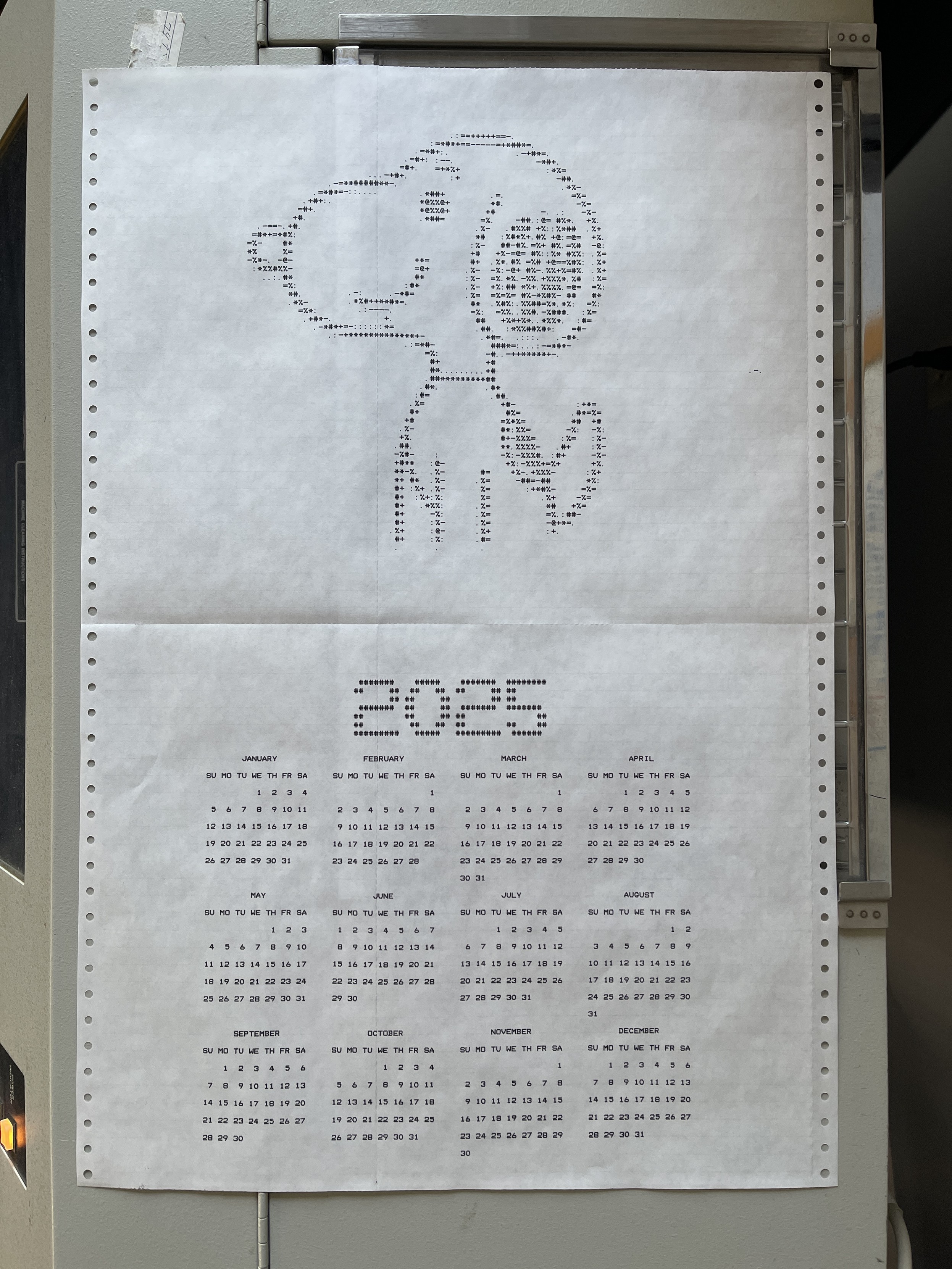


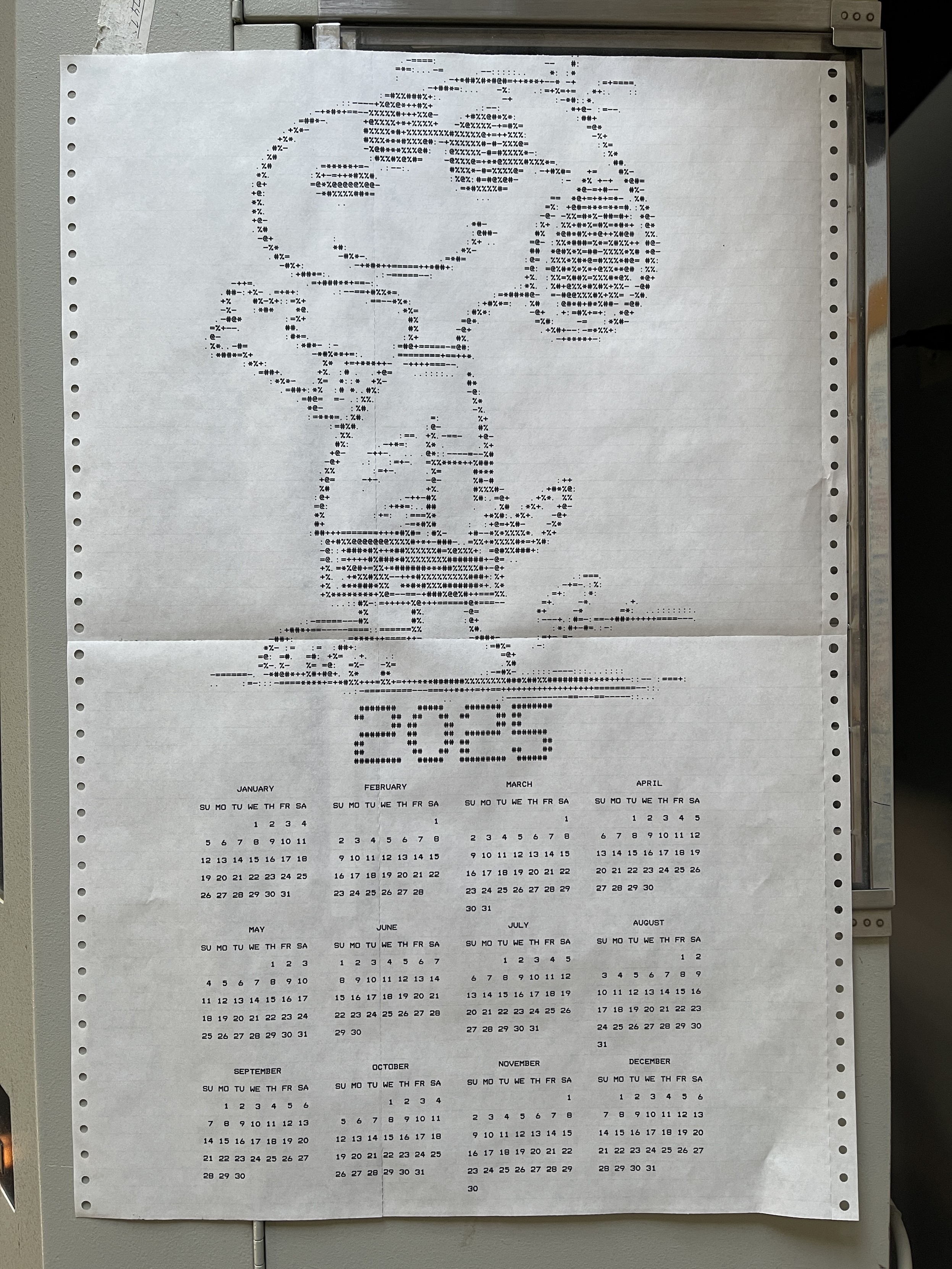
A second edition. Printronix P300 line matrix printer, 14 7/8" x 11" 20 lb. continuous green bar computer paper, 6 lines per inch, 132 columns.
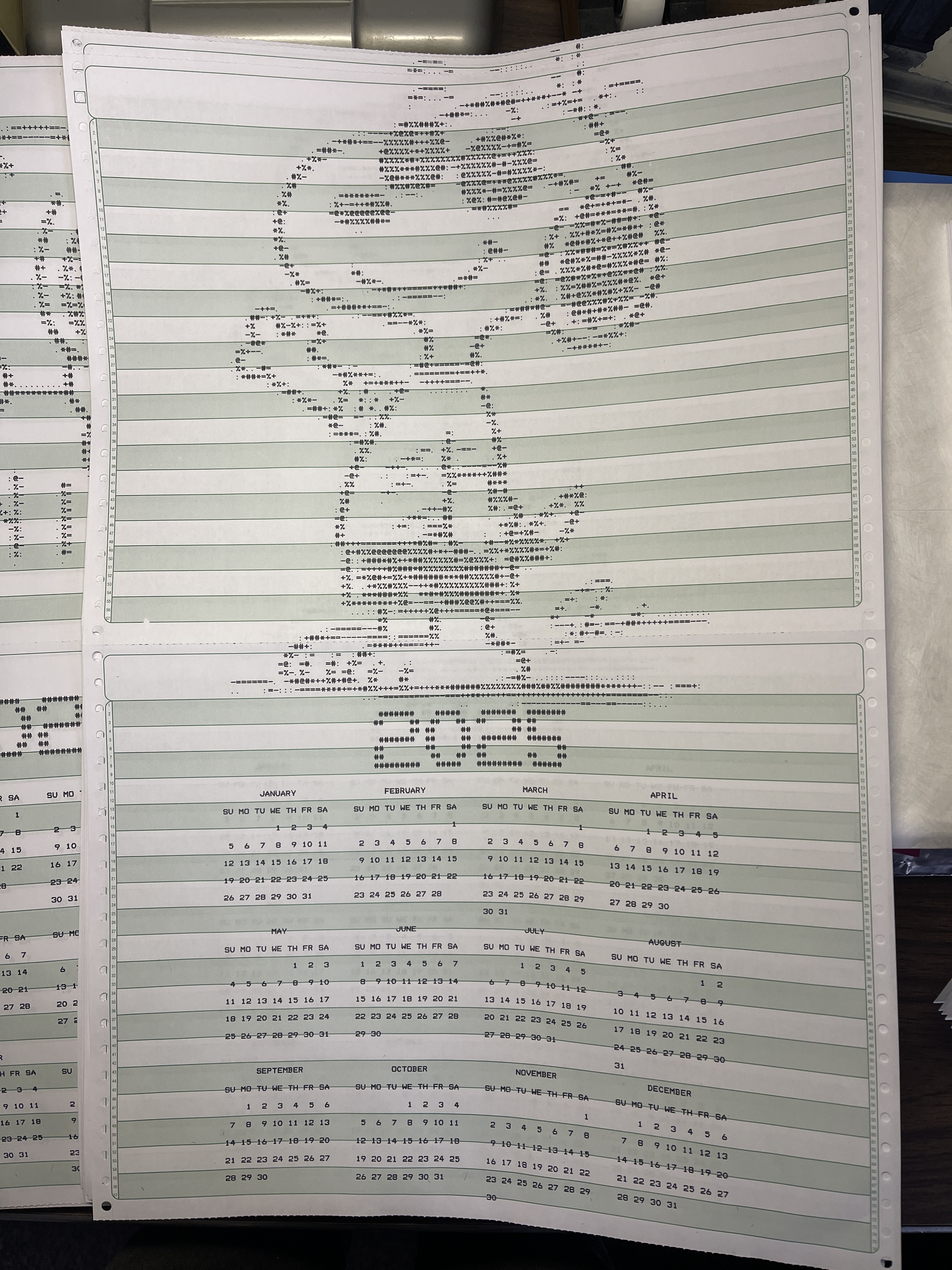
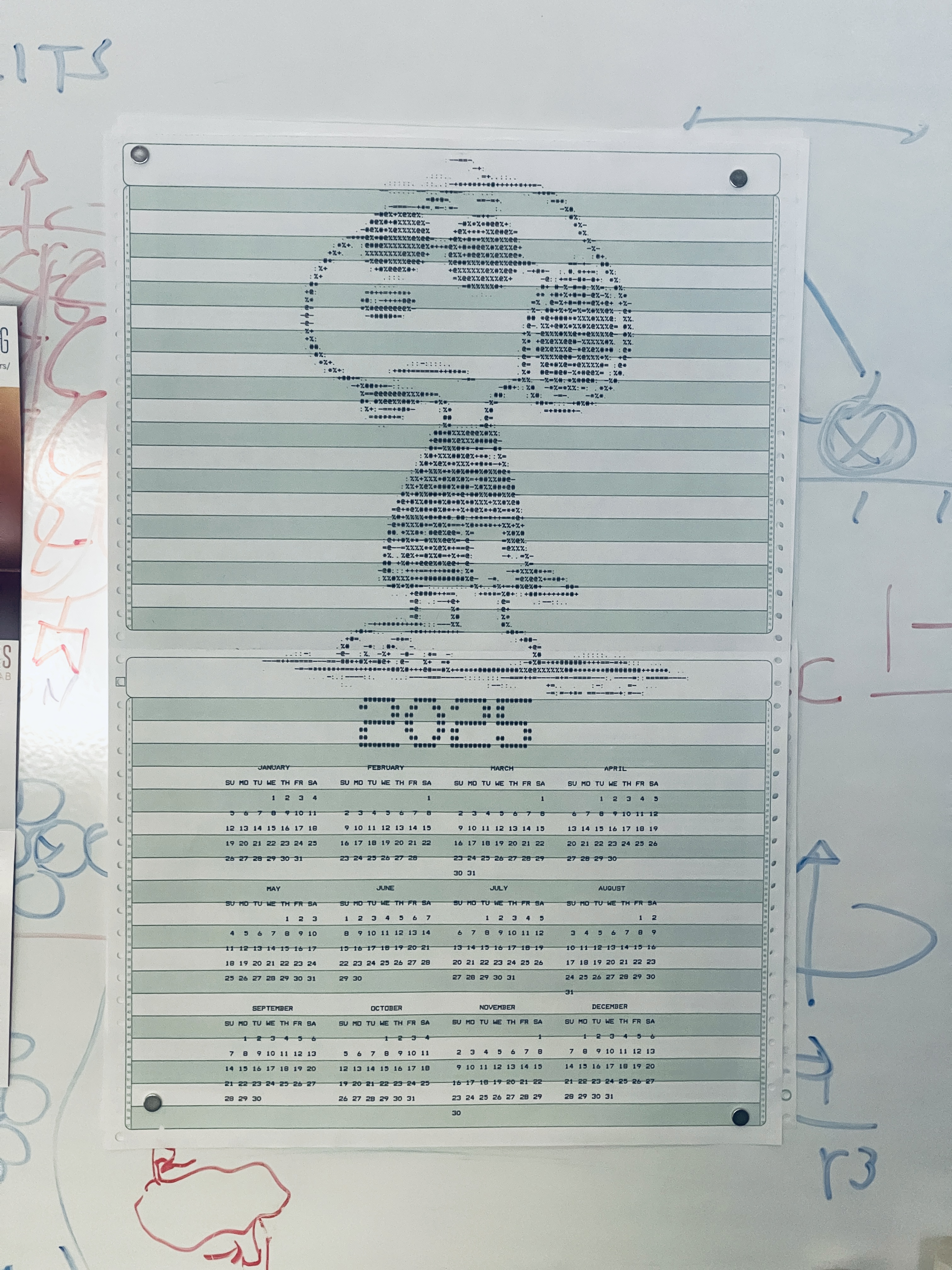
More copies were printed and distributed at Atari Party 2025 and Dream Lab 2025. Printronix P300 line matrix printer, 14 7/8" x 11" 20 lb. continuous green bar computer paper, printed on the blank side, 6 lines per inch, 132 columns.
2026 Bro Cool
- John K. Taber, ON COMPUTER CRIME (SENATE BILL S. 240), 1978
November 2025
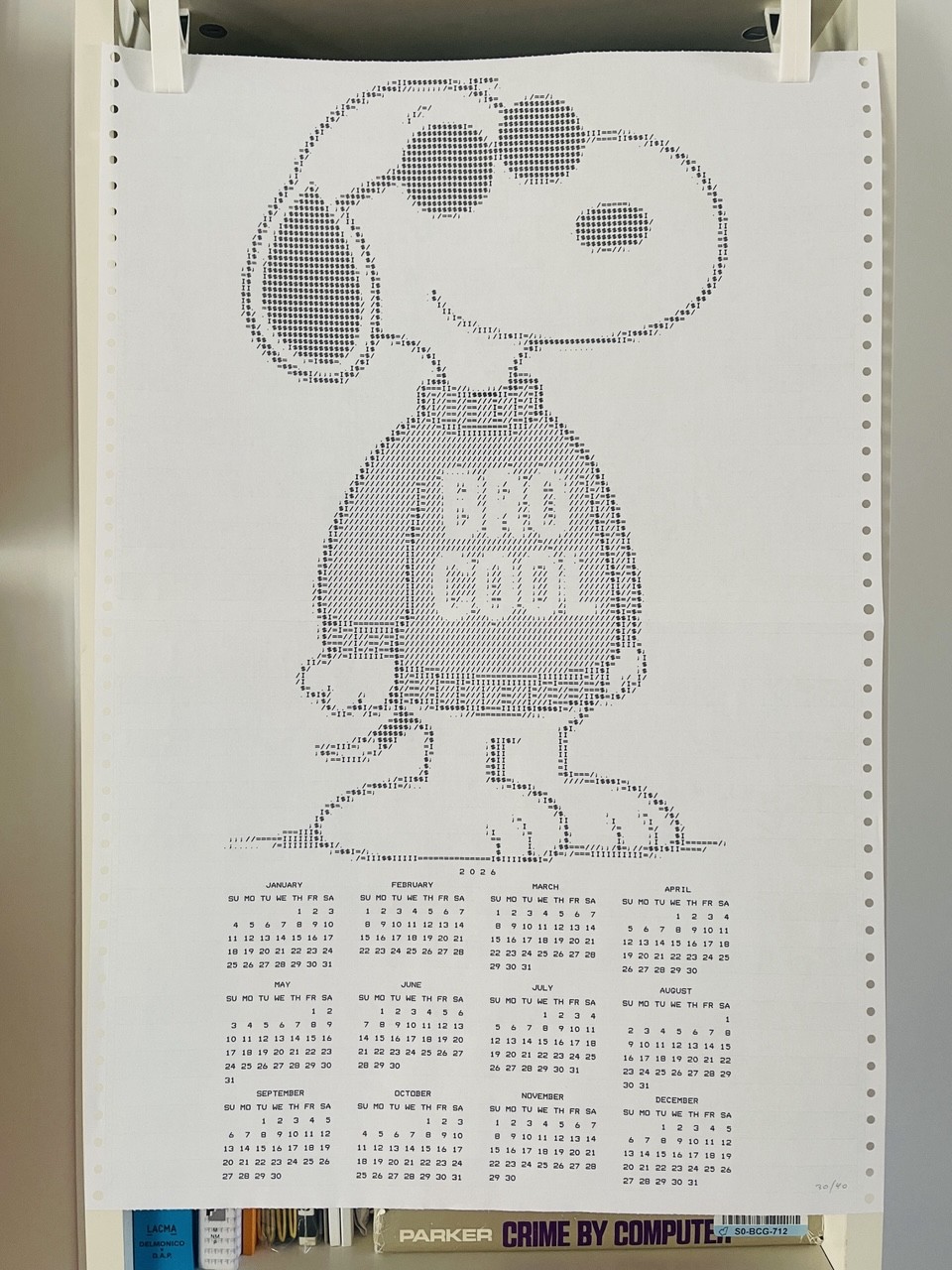
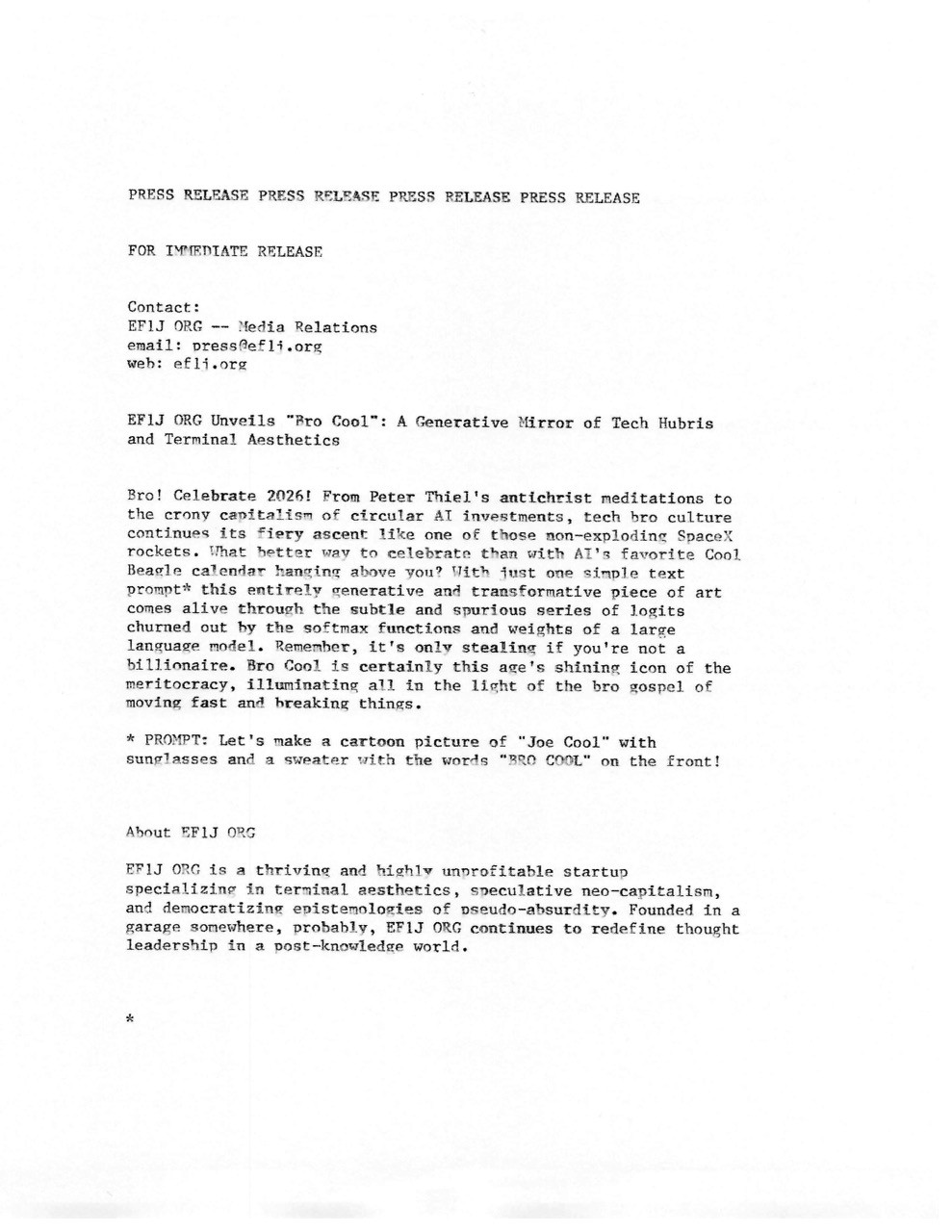
A 2026 calendar rendered on a wide format Printronix P300 line matrix printer. 14 7/8" x 11" 15 lb. continuous computer paper with green bars, printed on the blank side, 8 lines per inch, 132 columns. The image of "Bro Cool" was generated with a commercial large language model using the prompt:
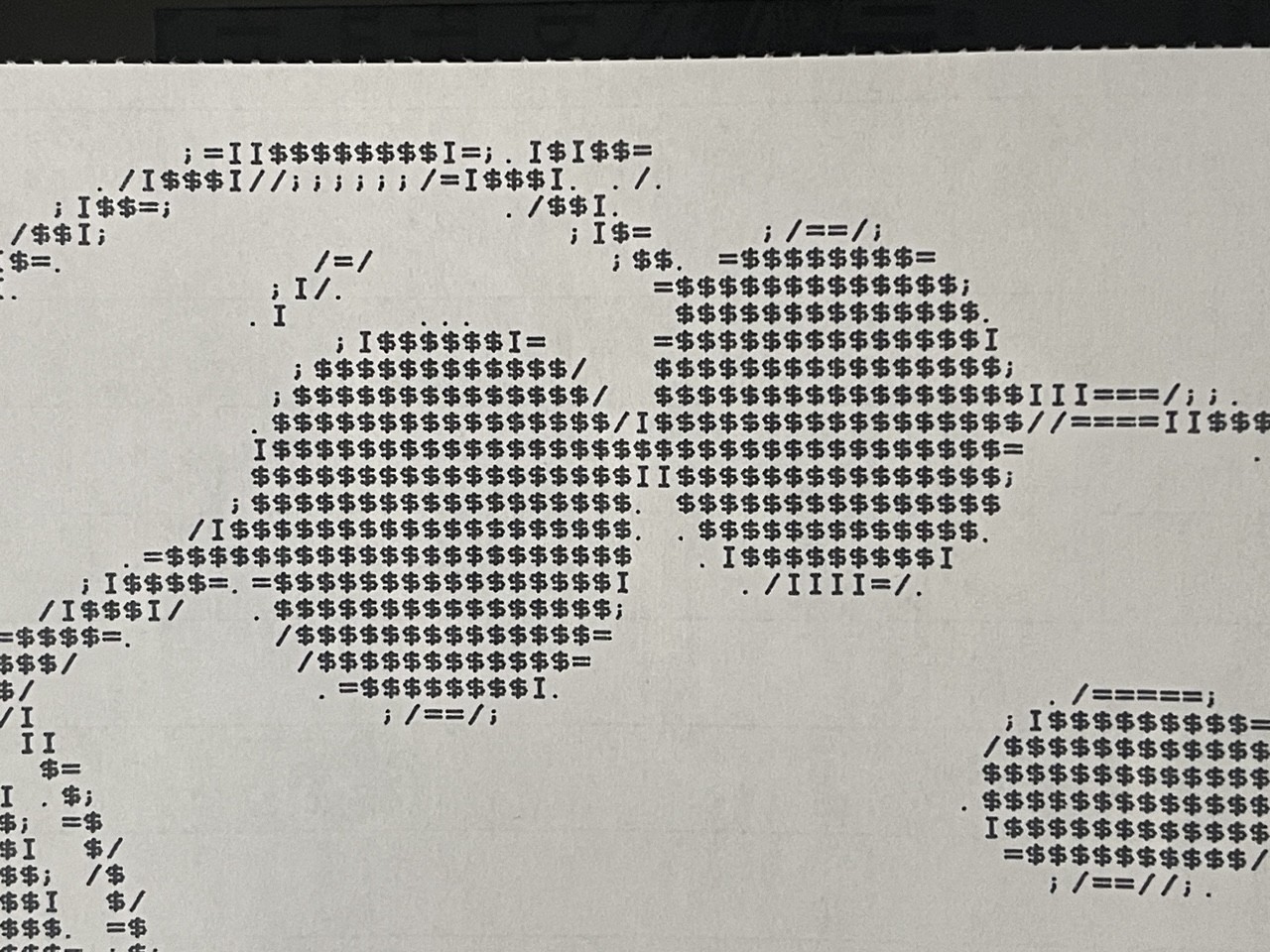
The resulting image was rendered in ASCII characters using custom software with a eight-level grayscale color map composed of the characters " .;/=I$".